

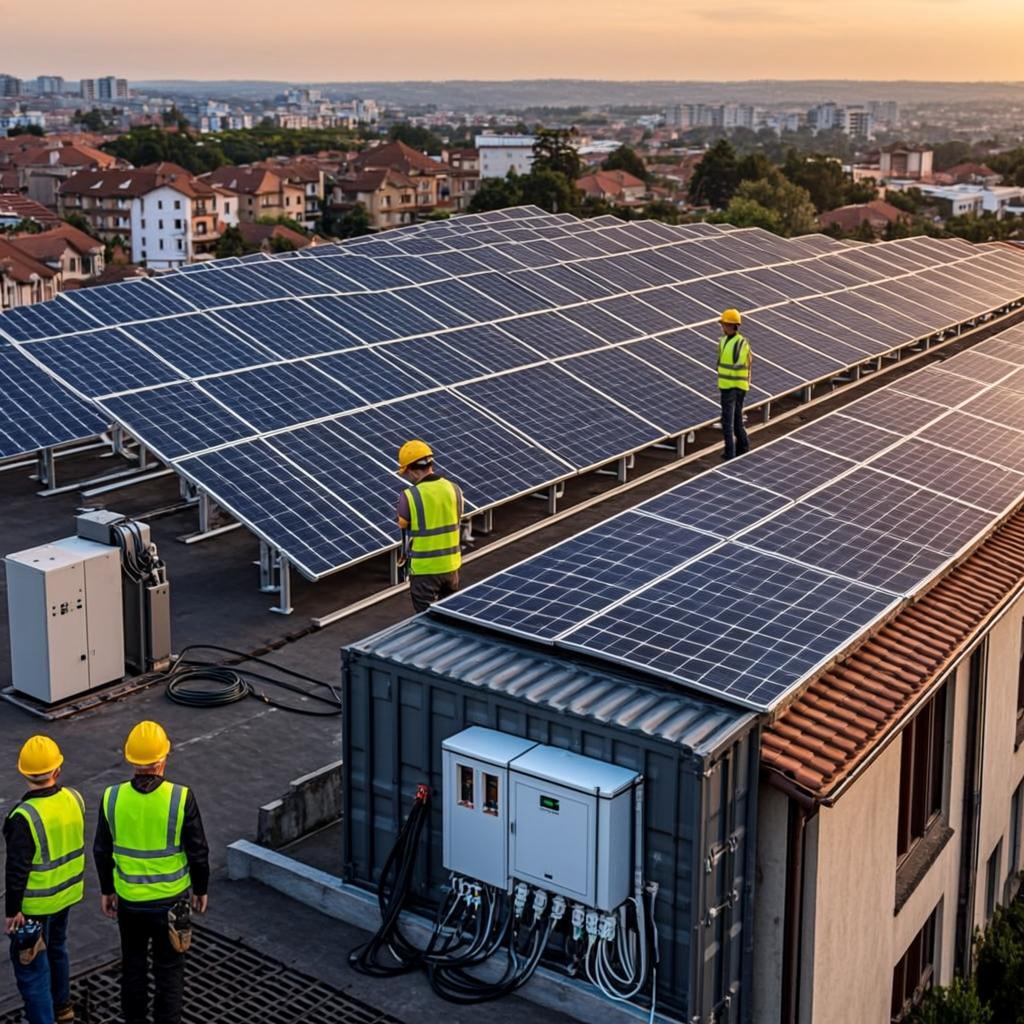
understanding solar panel specs
Understanding solar panel specs is fundamental for procurement professionals in the international renewable energy market. As global demand for photovoltaic (PV) systems surges, selecting the right
Understanding Solar Panel Specs: Essential Guide for B2B Buyers
1. Product Overview
Understanding solar panel specs is fundamental for procurement professionals in the international renewable energy market. As global demand for photovoltaic (PV) systems surges, selecting the right solar panels requires a deep dive into technical specifications to ensure compatibility, performance, and long-term value. This comprehensive guide demystifies solar panel specs, empowering importers, distributors, and project developers to make informed decisions.
Solar panels, or PV modules, convert sunlight into electricity through semiconductor materials like monocrystalline or polycrystalline silicon. Key to understanding solar panel specs is recognizing metrics under Standard Test Conditions (STC)—1,000 W/m² irradiance, 25°C cell temperature, and AM 1.5 spectrum. These standards provide a benchmark for comparing panels across manufacturers. Whether sourcing for utility-scale farms or commercial installations, mastering these specs minimizes risks such as underperformance or mismatched system designs.
In the B2B landscape, where bulk orders and long-term contracts dominate, overlooking specs can lead to costly mismatches. For instance, ignoring temperature coefficients might result in suboptimal output in hot climates. This overview sets the stage for exploring features, specs, and applications, helping you navigate supplier catalogs with confidence.
2. Key Features
At the heart of understanding solar panel specs lies a suite of features that define a panel's real-world efficacy. These elements go beyond marketing claims, offering quantifiable insights into durability, efficiency, and adaptability.
- High Module Efficiency: Typically 20-22% for premium monocrystalline panels, indicating the percentage of sunlight converted to usable power. Higher efficiency means more output from limited roof space—critical for urban commercial projects.
- Power Output Rating (Pmax): Measured in watts (Wp), ranging from 400-600Wp per panel. This spec under STC predicts peak performance, essential for system sizing.
- Temperature Coefficients: Values like -0.35%/°C for power ensure reliable output in varying climates. Panels with lower (more negative) coefficients degrade faster in heat.
- Low-Light Performance: Advanced PERC or bifacial cells excel in diffuse light, boosting yields in cloudy regions.
- Durability and Warranty: PID-free designs and 25-30 year linear power warranties guarantee longevity, backed by rigorous salt mist and ammonia corrosion tests.
- Certifications: IEC 61215/61730 compliance, UL listings, and TUV approvals verify safety and quality for international trade.
These features collectively enhance ROI, making panels suitable for diverse B2B applications. By prioritizing them, buyers avoid common pitfalls in understanding solar panel specs.
3. Technical Specifications
Delving deeper into understanding solar panel specs requires examining precise metrics. The table below outlines standard parameters for a typical 550Wp monocrystalline PERC half-cut module, providing a reference for bulk procurement.
| Parameter | Description | Symbol | Typical Value | Unit |
|---|---|---|---|---|
| Maximum Power Output | Peak power at STC | Pmax | 550 | Wp |
| Open Circuit Voltage | Voltage with no load | Voc | 49.5 | V |
| Short Circuit Current | Current with shorted terminals | Isc | 14.05 | A |
| Module Efficiency | Ratio of power output to input light | η | 21.3 | % |
| Operating Temperature Range | Safe working limits | - | -40 to +85 | °C |
| Temperature Coefficient (Pmax) | Power loss per °C above 25°C | α | -0.35 | %/°C |
| NOCT (Nominal Operating Cell Temp) | Cell temp at 800W/m², 20°C ambient, 1m/s wind | - | 45 ± 2 | °C |
| Dimensions | Length x Width x Thickness | - | 2278 x 1134 x 30 | mm |
| Weight | Net module weight | - | 27.5 | kg |
| Cell Type | Photovoltaic cell technology | - | Monocrystalline PERC, 144 half-cut | - |
| Maximum System Voltage | System voltage limit | - | 1500 | DC (V) |
| Junction Box | IP rating and diodes | - | IP68, 3 diodes | - |
| Warranty | Product and linear power | - | 12 years / 30 years (84.8% at year 30) | Years |
These specs form the backbone of understanding solar panel specs. Always request datasheets from suppliers for exact values, and consider tolerances (±3% for Pmax).
4. Application Scenarios
Understanding solar panel specs unlocks tailored solutions across industries. Specs dictate suitability for specific environments and load requirements.
Commercial Rooftop Systems: High-efficiency panels (21%+) with low temperature coefficients excel here, maximizing kWh from constrained spaces amid HVAC heat.
Utility-Scale Solar Farms: Focus on high Pmax (500Wp+), bifacial designs for ground-mounted arrays, and robust mechanical load ratings (5400Pa snow, 2400Pa wind).
Off-Grid and Remote Installations: Prioritize wide operating ranges (-40°C to +85°C) and high Voc for battery charging in harsh conditions like deserts or arctic outposts.
Floating PV Projects: Ammonia-resistant frames and high PID resistance ensure longevity on water bodies.
Industrial and Agri-PV: Dust-resistant coatings and optimal NOCT support shaded or soiled environments. By aligning specs to scenarios, B2B buyers optimize energy yield and project timelines.
5. Advantages
Mastering understanding solar panel specs yields tangible B2B benefits, from cost efficiency to regulatory compliance.
- Optimized System Design: Matching Voc/Isc to inverters prevents clipping losses, boosting overall efficiency by 5-10%.
- Climate Adaptability: Selecting appropriate coefficients ensures consistent output, vital for equatorial or temperate exports.
- Cost-Effective Sourcing: Specs enable value comparisons, avoiding overpaying for branded vs. Tier 1 equivalents.
- Enhanced Durability: IEC-tested specs predict 25+ year lifespans, reducing O&M expenses.
- ROI Acceleration: Accurate performance modeling via specs shortens payback periods to under 5 years.
- Global Compliance: Understanding certifications streamlines customs and installations worldwide.
6. Why Choose Us
As specialists in solar PV for international trade, we excel in guiding clients through understanding solar panel specs. Our Tier 1 panels from audited factories feature bankable datasheets, third-party verifications, and customizable specs for OEM needs.
With decades of export experience, we provide detailed spec consultations, ensuring seamless integration into EPC projects. Our global logistics handle containerized shipments, while technical support deciphers NOCT vs. STC nuances. Partner with us for specs-driven procurement that delivers superior performance and peace of mind.
7. FAQ
What does STC mean in understanding solar panel specs?
STC (Standard Test Conditions) standardizes testing at 1,000 W/m², 25°C, and AM 1.5, enabling fair comparisons. Real-world output varies; use NOCT for approximations.
How do temperature coefficients impact solar panel performance?
These measure degradation per °C rise. A -0.35%/°C Pmax coefficient means 3.5% loss at 40°C, crucial for hot climates.
What is the difference between monocrystalline and polycrystalline specs?
Monocrystalline offers higher efficiency (20-22%) and better low-light performance; polycrystalline is cost-effective (17-19%) with similar durability.
Why is module efficiency a key spec for B2B buyers?
It determines space efficiency—higher η reduces balance-of-system costs in space-limited installs like warehouses.
How to verify solar panel specs from suppliers?
Request EL images, flash reports, and third-party certs like DNV or RETC. Cross-check with tools like PVsyst simulations.
What warranties should I expect when understanding solar panel specs?
Standard: 12-15 years product, 25-30 years linear power (80-85% retention). Bifacial models often extend to 30 years at 84.95%.
Related product
- English
- Françai
- Español
- Deutsch
- Română
- العربية
- 한국어
- 日本語
- Italiano
- Português
- Gaeilge
- Dansk
- Čeština
- Русский
- Afrikaans
- Euskara
- Català
- Esperanto
- हिन्दी
- Ελληνικά
- Bahasa Melayu
- Polski
- Српски
- Kiswahili
- ภาษาไทย
- Tiếng Việt
- Türkçe
- Svenska
- Cymraeg
- Slovenčina
- Latviešu
- Malti
- Magyar
- Galego
- ગુજરાતી
- Eesti Keel
- বাংলা
- Shqip
- беларуская мова
- Nederlands
- Tagalog
- ქართული
- Íslenska
- Kreyòl Ayisyen
- Lietuvių
- Norsk
- slovenščina
- தமிழ்
- Українська
- ײִדיש
- اردو
- తెలుగు
- فارسی
- македонски
- ಕನ್ನಡ
- Bahasa Indonesia
- עברית
- Suomi
- Hrvatski
- Български
- Azerbaijani