

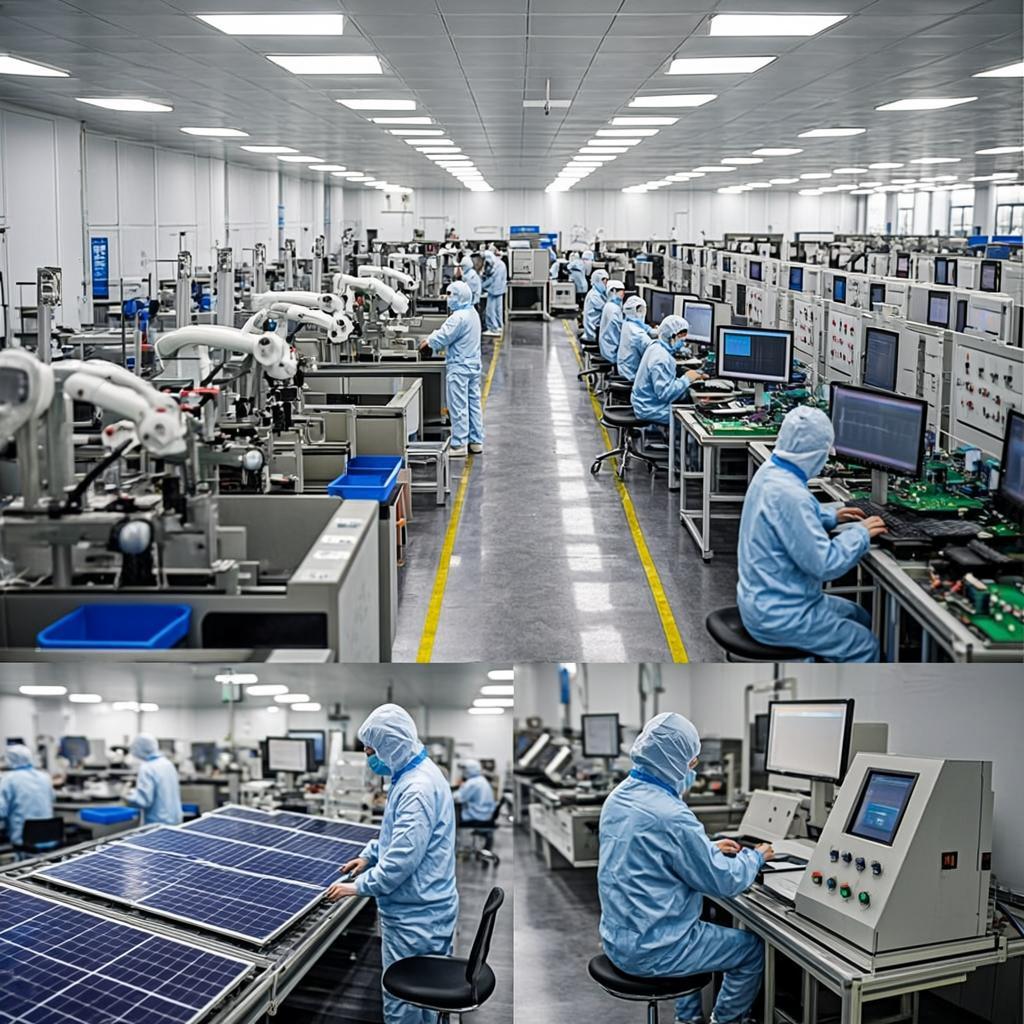
solar panel types and efficiency
Understanding solar panel types and efficiency is essential for businesses seeking reliable, high-performance photovoltaic solutions in international trade. Our comprehensive range encompasses
Solar Panel Types and Efficiency: Optimize Your Solar Investments
1. Product Overview
Understanding solar panel types and efficiency is essential for businesses seeking reliable, high-performance photovoltaic solutions in international trade. Our comprehensive range encompasses monocrystalline, polycrystalline, thin-film, PERC, bifacial, and half-cut solar panels, each optimized for varying efficiency levels to meet diverse project demands. Efficiency, measured as the percentage of sunlight converted into usable electricity, typically ranges from 15% in standard polycrystalline models to over 22% in advanced N-type TOPCon and HJT technologies.
In today's competitive renewable energy market, selecting the right combination of solar panel types and efficiency directly impacts return on investment (ROI), energy yield, and long-term durability. Monocrystalline panels excel in space-constrained installations with efficiencies up to 24%, while polycrystalline options offer cost-effective solutions at 16-20% efficiency. Thin-film variants, including CIGS and CdTe, provide flexibility and low-light performance at 10-13% efficiency, ideal for large-scale utility projects. Our panels undergo rigorous testing to IEC standards, ensuring superior performance across climates. By focusing on solar panel types and efficiency, we empower B2B clients to achieve sustainable energy goals with minimal degradation rates below 0.5% annually.
2. Key Features
- High-Efficiency Monocrystalline Cells: Up to 24% efficiency with black silicon technology for maximum power output in limited spaces.
- Cost-Effective Polycrystalline Design: 18-20% efficiency balanced with affordability, perfect for budget-conscious commercial arrays.
- Flexible Thin-Film Options: Lightweight CIGS panels at 12-13% efficiency, with superior performance in diffuse light and high temperatures.
- PERC and TOPCon Enhancements: Passivated emitter rear cell technology boosts efficiency by 2-4% over standard types, reducing LCOE (levelized cost of energy).
- Bifacial Modules: Capture reflected light for 10-30% additional yield, achieving effective efficiencies beyond 25% in optimal ground-mounted setups.
- Half-Cut Cell Configuration: Minimizes shading losses and resistance, improving overall solar panel types and efficiency by up to 5%.
- Anti-PID and Anti-LID Protection: Ensures long-term stability with less than 1% first-year degradation.
- Tempered Glass and Aluminum Framing: Wind load resistance up to 5400 Pa, hail resistance certified to 25mm at 23 m/s.
These features across our solar panel types and efficiency portfolio ensure versatility for rooftop, ground-mount, and floating solar applications, backed by 25-30 year linear power warranties.
3. Technical Specifications
| Solar Panel Type | Efficiency Range (%) | Power Output (W) | Cell Type | Dimensions (mm) | Weight (kg) | Temperature Coefficient (Pmax, %/°C) |
|---|---|---|---|---|---|---|
| Monocrystalline PERC | 20.5 - 22.5 | 400-550 | 182mm M10 | 1722 x 1134 x 30 | 21.5 | -0.35 |
| Polycrystalline | 17.5 - 20.0 | 350-450 | 156mm P-type | 1679 x 1002 x 35 | 19.8 | -0.39 |
| Thin-Film CIGS | 12.0 - 13.5 | 100-150 per m² | Copper Indium Gallium Selenide | Flexible: 1000 x 600 x 2 | 2.5 | -0.32 |
| Bifacial Glass-Glass | 21.0 - 23.0 (front), +10-30% bifacial gain | 450-600 | N-type TOPCon | 2384 x 1303 x 30 | 33.2 | -0.30 |
| Half-Cut Monocrystalline | 21.5 - 24.0 | 500-700 | 210mm Half-cells | 2256 x 1134 x 35 | 28.5 | -0.34 |
| HJT Heterojunction | 22.5 - 24.5 | 600-720 | Crystalline-Amorphous Silicon | 2308 x 1134 x 30 | 24.8 | -0.26 |
All specifications adhere to IEC 61215 and IEC 61730 standards, with tolerances of ±3% on power output. Certifications include UL, TUV, and CE for global compliance.
4. Application Scenarios
Selecting the optimal solar panel types and efficiency depends on specific deployment environments. High-efficiency monocrystalline and HJT panels are ideal for commercial rooftops and urban solar farms where space is premium, delivering superior yields in direct sunlight regions like the Middle East or Southwest US.
Polycrystalline modules shine in large-scale ground-mounted utility projects in cost-sensitive markets such as India or Latin America, balancing solar panel types and efficiency with economical pricing. Thin-film CIGS excels in hot, humid climates like Southeast Asia or Australia, maintaining performance at temperatures exceeding 60°C with minimal efficiency drop-off.
Bifacial panels optimize agrivoltaic systems, tracking installations, and reflective surfaces in snowy or albedo-rich areas like Europe or Canada, enhancing overall system efficiency. Half-cut configurations suit shaded residential or industrial sites, reducing micro-cracks and string losses. For marine and floating PV, our corrosion-resistant options ensure reliability in offshore wind-solar hybrids.
5. Advantages
Our solar panel types and efficiency lineup provides unmatched advantages for B2B procurement. Firstly, superior efficiency translates to higher energy density, reducing balance-of-system costs by 20-30% through fewer panels and inverters needed. Advanced passivation technologies like PERC and TOPCon minimize recombination losses, ensuring 85-90% output retention after 25 years.
Versatility across types allows tailored solutions: thin-film for building-integrated photovoltaics (BIPV), bifacial for dual-sided generation. Environmental resilience includes PID-free operation and low light-induced degradation (LID), critical for high-latitude installations. Economically, our panels lower the LCOE by 15% compared to legacy types, with rapid ROI in under 5 years for most commercial setups.
Furthermore, consistent quality from Tier 1 manufacturers guarantees supply chain reliability, with bankable warranties and full lifecycle support. By prioritizing solar panel types and efficiency, clients achieve scalable, future-proof renewable portfolios compliant with global ESG standards.
6. Why Choose Us
As a leading supplier in international trade, we specialize in solar panel types and efficiency, offering end-to-end solutions from OEM customization to logistics. Our global network ensures competitive MOQs, flexible payment terms, and delivery within 4-6 weeks to over 100 countries. With in-house R&D, we stay ahead of trends like 25%+ efficiency N-type cells and tandem perovskites.
Backed by ISO 9001 certification and partnerships with top silicon wafer producers, we provide detailed datasheets, simulation tools, and third-party testing reports. Our expertise demystifies solar panel types and efficiency, helping clients optimize for irradiance, tilt, and azimuth via PVsyst modeling. Choose us for transparent pricing, zero-defect policies, and commitment to sustainable manufacturing with 100% recyclable frames.
7. FAQ
What are the main solar panel types and their efficiency levels?
The primary types include monocrystalline (20-24%), polycrystalline (17-20%), thin-film (10-13%), bifacial (21-25% effective), and emerging HJT/TOPCon (22-25%). Efficiency varies by cell technology and manufacturing.
How does efficiency impact solar project ROI?
Higher solar panel types and efficiency reduce required array size, lowering installation costs and accelerating payback periods by 1-2 years while maximizing kWh output.
Which type is best for hot climates?
Thin-film CIGS or monocrystalline with low temp coefficients (-0.30%/°C) perform best, losing less than 0.4% efficiency per degree above 25°C.
What warranties cover your panels?
25-year linear power output (80-85% retention), 12-year product workmanship, extendable for bifacial models.
Can I customize panel types for my project?
Yes, we offer tailored solar panel types and efficiency specs, including half-cell, multi-busbar, and frame colors for branding.
Related product
- English
- Françai
- Español
- Deutsch
- Română
- العربية
- 한국어
- 日本語
- Italiano
- Português
- Gaeilge
- Dansk
- Čeština
- Русский
- Afrikaans
- Euskara
- Català
- Esperanto
- हिन्दी
- Ελληνικά
- Bahasa Melayu
- Polski
- Српски
- Kiswahili
- ภาษาไทย
- Tiếng Việt
- Türkçe
- Svenska
- Cymraeg
- Slovenčina
- Latviešu
- Malti
- Magyar
- Galego
- ગુજરાતી
- Eesti Keel
- বাংলা
- Shqip
- беларуская мова
- Nederlands
- Tagalog
- ქართული
- Íslenska
- Kreyòl Ayisyen
- Lietuvių
- Norsk
- slovenščina
- தமிழ்
- Українська
- ײִדיש
- اردو
- తెలుగు
- فارسی
- македонски
- ಕನ್ನಡ
- Bahasa Indonesia
- עברית
- Suomi
- Hrvatski
- Български
- Azerbaijani