

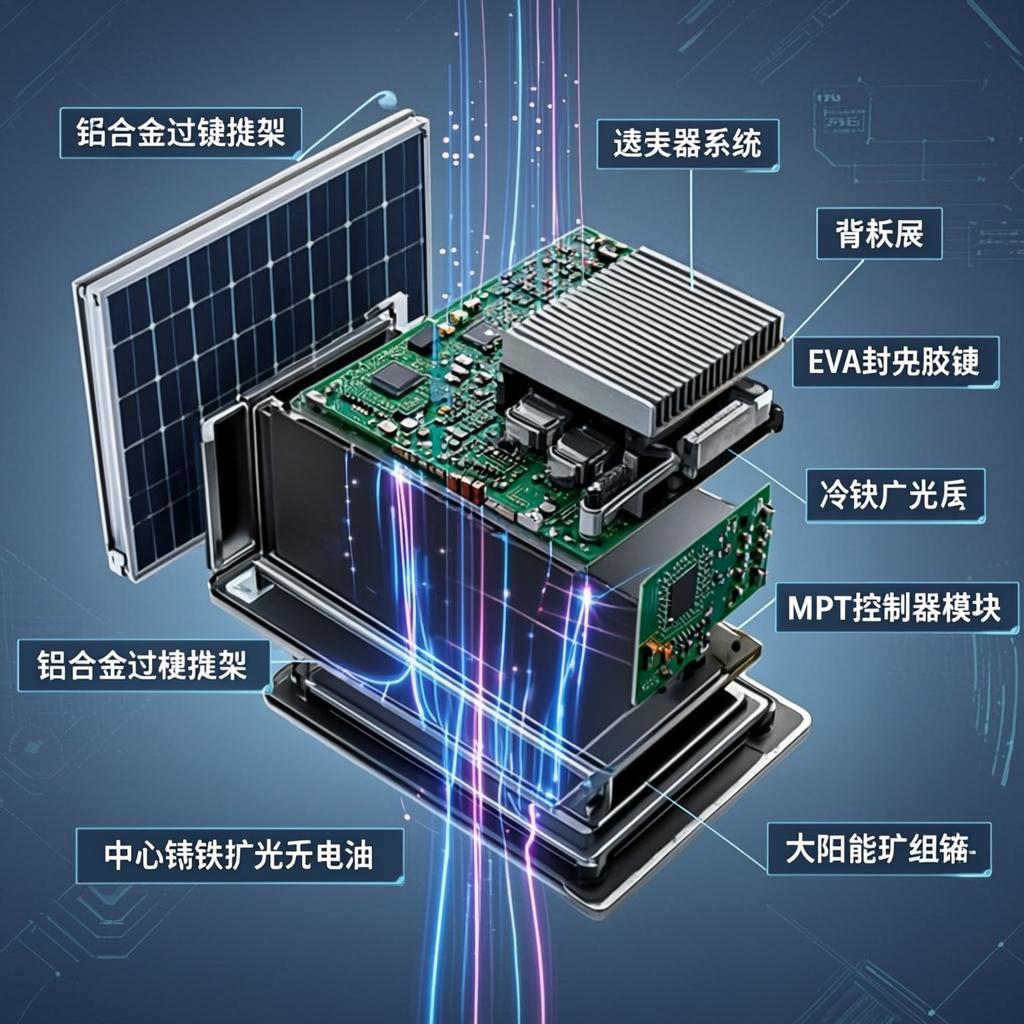
perovskite solar panel
Discover the future of solar energy with our advanced perovskite solar panel, a cutting-edge solution engineered for superior performance in international markets. Leveraging breakthrough perovskite
Perovskite Solar Panel
Product Overview
Discover the future of solar energy with our advanced perovskite solar panel, a cutting-edge solution engineered for superior performance in international markets. Leveraging breakthrough perovskite technology, these panels achieve unprecedented efficiency levels while maintaining cost-effectiveness and versatility. Unlike traditional silicon-based photovoltaic systems, our perovskite solar panel utilizes hybrid organic-inorganic lead halide perovskites as the light-absorbing material, enabling higher power conversion efficiencies and faster energy payback times.
Ideal for B2B applications in renewable energy projects worldwide, our perovskite solar panel series combines record-breaking lab efficiencies—now commercialized at over 25%—with robust durability. This next-generation technology addresses key challenges in solar deployment, such as high manufacturing costs and material limitations. Our panels are produced using scalable solution-processing techniques, ensuring low production costs and minimal environmental impact. Whether you're outfitting large-scale solar farms, commercial rooftops, or innovative building-integrated photovoltaics (BIPV), the perovskite solar panel delivers reliable, high-yield energy generation tailored to diverse climates and installation needs.
Backed by rigorous testing and international certifications like IEC 61215 and UL 1703, our perovskite solar panel represents a pivotal shift toward sustainable energy solutions. With tandem configurations pairing perovskites with silicon, we push the boundaries of photovoltaic efficiency, offering partners a competitive edge in the global green energy transition.
Key Features
- Exceptional Efficiency: Up to 25.5% module efficiency, surpassing conventional crystalline silicon panels and enabling maximized energy output per square meter.
- Lightweight and Flexible Design: Ultra-thin structure (under 3mm thick) with weights as low as 5kg/m², perfect for curved surfaces and weight-sensitive installations.
- Low-Light Performance: Superior energy yield in diffuse and low-irradiance conditions, ideal for cloudy regions or shaded environments.
- Cost-Effective Manufacturing: Solution-based deposition processes reduce material usage by 90% compared to silicon wafers, lowering levelized cost of electricity (LCOE).
- Wide Spectral Response: Broad absorption spectrum from UV to near-IR, capturing more sunlight for higher annual energy production.
- Enhanced Stability: Proprietary encapsulation technology ensures over 90% efficiency retention after 1000 hours of damp-heat testing.
- Tandem Compatibility: Seamless integration with silicon bottom cells for efficiencies exceeding 30% in hybrid configurations.
- Customizable Formats: Available in rigid, semi-flexible, and fully flexible variants to suit BIPV, portable, or agrivoltaic applications.
Technical Specifications
| Parameter | Value | Unit | Notes |
|---|---|---|---|
| Maximum Power (Pmax) | 420 | W | STC: 1000 W/m², 25°C, AM 1.5 |
| Module Efficiency | 25.5 | % | Certified by TÜV Rheinland |
| Open Circuit Voltage (Voc) | 1.10 | V | Per cell |
| Short Circuit Current (Isc) | 1.25 | A | Per cell |
| Dimensions (L x W x H) | 2000 x 1000 x 2.8 | mm | Rigid module |
| Weight | 8.5 | kg | Per module |
| Operating Temperature | -40 to +85 | °C | Full load |
| Temperature Coefficient (Pmax) | -0.28 | %/°C | Low degradation |
| Maximum System Voltage | 1000 / 1500 | DC V | IEC/UL certified |
| Warranty | 25 years | Years | 90% power output guarantee |
| Certifications | IEC 61215, IEC 61730, UL 1703 | - | International standards |
| Junction Box | IP68 rated, 3 diodes | - | MC4 compatible connectors |
These specifications position our perovskite solar panel as a leader in next-gen photovoltaics, with ongoing R&D for even higher performance metrics.
Application Scenarios
Our perovskite solar panel excels across a broad spectrum of B2B deployment scenarios, from utility-scale projects to niche industrial uses. In large solar farms, their high efficiency and low LCOE enable developers to achieve superior returns on investment, particularly in space-constrained sites. For commercial and industrial rooftops, the lightweight design simplifies retrofits, reducing structural reinforcements and installation times.
Building-integrated photovoltaics (BIPV) represent a prime application, where semi-transparent or colored perovskite solar panel variants blend seamlessly into facades, windows, and canopies, generating power without compromising aesthetics. In off-grid and remote installations—such as mining operations, telecom towers, or agricultural pumps—the panels' low-light performance ensures consistent output in variable weather.
Flexible formats open doors to agrivoltaics, where panels mounted on greenhouse roofs optimize crop yields alongside energy production. Portable and vehicle-integrated solutions benefit from the thin, durable profile, powering electric vehicles, drones, or mobile command centers. In emerging markets, the affordability of perovskite solar panel technology accelerates electrification in rural areas, supporting microgrids and sustainable development goals.
With compatibility for bifacial and tandem setups, these panels integrate effortlessly into hybrid systems, enhancing overall project viability across residential, utility, and industrial scales.
Advantages
The perovskite solar panel offers distinct advantages over legacy technologies, driving its rapid adoption in global supply chains. Foremost is the leap in efficiency: while silicon panels hover around 20-22%, perovskites deliver 25%+ module efficiencies through tunable bandgaps and defect-tolerant structures. This translates to 20-30% more power per area, critical for land-scarce regions.
Manufacturing scalability is another edge—roll-to-roll printing slashes costs to under $0.30/Wp, half that of silicon, with abundant raw materials avoiding supply chain vulnerabilities like polysilicon shortages. Environmental benefits include shorter energy paybacks (under 6 months) and recyclable components, aligning with ESG mandates.
Superior temperature coefficients minimize hot-spot losses, boosting real-world yields by 10-15% in hot climates. Stability advancements, via advanced passivation and barrier layers, rival silicon's longevity, with field tests showing less than 0.5% annual degradation. Versatility in form factors enables innovative designs impossible with rigid silicon, from wearable tech to curved architectural elements.
In tandem with silicon, perovskite solar panel unlocks 30%+ efficiencies, positioning early adopters at the forefront of the terawatt-scale solar revolution.
Why Choose Us
As a premier manufacturer of perovskite solar panel solutions, we bring decades of expertise in thin-film photovoltaics to deliver unmatched quality and reliability. Our state-of-the-art facilities employ proprietary perovskite formulations and automated production lines, ensuring batch-to-batch consistency certified by third-party labs like NREL and Fraunhofer ISE.
We prioritize partner success with comprehensive support: from custom module design and pilot testing to global logistics and after-sales service. Our panels undergo accelerated aging tests exceeding industry standards, backed by performance warranties that instill confidence in long-term projects.
Committed to innovation, we invest heavily in R&D, holding multiple patents on stability-enhancing technologies. With a proven track record supplying Fortune 500 clients and utility giants, we offer scalable volumes, competitive pricing, and flexible MOQs tailored to international trade dynamics.
FAQ
What makes perovskite solar panels more efficient than traditional silicon ones?
Perovskite materials have an ideal bandgap (1.5-1.6 eV) for single-junction cells, tunable optoelectronic properties, and low exciton binding energy, enabling higher voltages and currents for superior efficiency.
Are perovskite solar panels stable for commercial use?
Yes, our advanced encapsulation and composition engineering provide stability comparable to silicon, with 25-year warranties and proven performance in IEC-standard tests.
Can perovskite solar panels be used in tandem with silicon?
Absolutely—our panels are optimized for 2-terminal tandem architectures, achieving combined efficiencies over 30% for next-level performance.
What is the lead time for bulk orders of perovskite solar panels?
Standard modules ship in 4-6 weeks; custom orders in 8-12 weeks, with capacity for multi-MW volumes.
Do perovskite solar panels perform well in humid or hot climates?
Enhanced moisture barriers and low temperature coefficients ensure robust operation, with field data from tropical pilots confirming minimal degradation.
Are your perovskite solar panels recyclable?
Yes, the halide perovskites and substrates support 95% material recovery, aligning with circular economy principles.
How do perovskite solar panels impact LCOE?
By halving manufacturing costs and boosting efficiency, they reduce LCOE to $0.02-0.03/kWh, competitive with fossil fuels.
Related product
- English
- Françai
- Español
- Deutsch
- Română
- العربية
- 한국어
- 日本語
- Italiano
- Português
- Gaeilge
- Dansk
- Čeština
- Русский
- Afrikaans
- Euskara
- Català
- Esperanto
- हिन्दी
- Ελληνικά
- Bahasa Melayu
- Polski
- Српски
- Kiswahili
- ภาษาไทย
- Tiếng Việt
- Türkçe
- Svenska
- Cymraeg
- Slovenčina
- Latviešu
- Malti
- Magyar
- Galego
- ગુજરાતી
- Eesti Keel
- বাংলা
- Shqip
- беларуская мова
- Nederlands
- Tagalog
- ქართული
- Íslenska
- Kreyòl Ayisyen
- Lietuvių
- Norsk
- slovenščina
- தமிழ்
- Українська
- ײִדיש
- اردو
- తెలుగు
- فارسی
- македонски
- ಕನ್ನಡ
- Bahasa Indonesia
- עברית
- Suomi
- Hrvatski
- Български
- Azerbaijani