

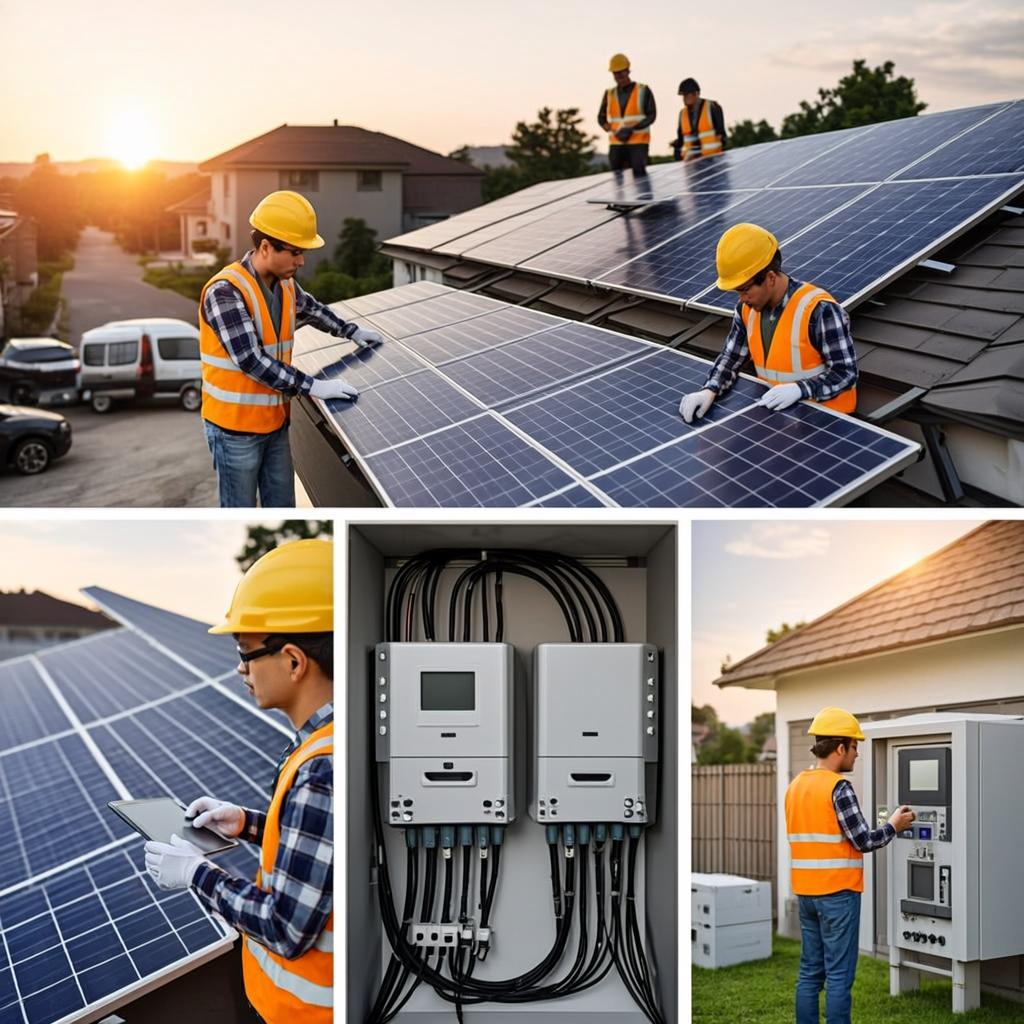
monocrystalline solar panel
Our monocrystalline solar panel represents the pinnacle of photovoltaic technology, engineered for superior energy conversion and long-term reliability in diverse international markets. Crafted from
High-Efficiency Monocrystalline Solar Panel
Product Overview
Our monocrystalline solar panel represents the pinnacle of photovoltaic technology, engineered for superior energy conversion and long-term reliability in diverse international markets. Crafted from high-purity silicon crystals grown in a single continuous process, each monocrystalline solar panel delivers exceptional efficiency rates, often exceeding 22%, making it the preferred choice for B2B projects demanding maximum power output from limited space.
Designed for industrial-scale installations, residential rooftops, and off-grid systems, this monocrystalline solar panel withstands harsh environmental conditions, including high winds, heavy snow loads, and extreme temperatures. With advanced half-cut cell technology and multi-busbar (MBB) design, it minimizes power losses and enhances performance under partial shading. Ideal for exporters and importers in the renewable energy sector, our monocrystalline solar panel complies with international standards such as IEC 61215 and IEC 61730, ensuring seamless integration into global supply chains.
Whether you're outfitting commercial solar farms or powering remote industrial sites, this monocrystalline solar panel offers a robust solution with a proven lifespan of over 25 years, backed by minimal degradation rates of less than 0.5% annually. Its sleek black frame and uniform appearance not only optimize aesthetics but also maximize energy yield, positioning it as a top-tier investment for forward-thinking businesses worldwide.
Key Features
- Ultra-High Efficiency: Up to 22.5% module efficiency, leveraging PERC (Passivated Emitter and Rear Cell) technology for superior light absorption and reduced recombination losses in every monocrystalline solar panel.
- Half-Cut Cell Design: Reduces resistive losses by 75% and boosts shade tolerance, ensuring consistent output from monocrystalline solar panels even in suboptimal conditions.
- Multi-Busbar Technology: 12 or 16 busbars per cell lower series resistance, improving current collection and overall durability of the monocrystalline solar panel.
- Anti-PID and Anti-LID: Potential Induced Degradation (PID) and Light Induced Degradation (LID) resistance guarantee long-term stability for monocrystalline solar panels in utility-scale deployments.
- Enhanced Frame and Encapsulation: Anodized aluminum frame with 35mm thickness supports snow loads up to 5400Pa and wind loads up to 2400Pa, paired with tempered glass for optimal monocrystalline solar panel protection.
- Low-Light Performance: Excellent energy generation during dawn, dusk, and cloudy days, making monocrystalline solar panels versatile for varied climates.
- Certifications: TUV, UL, CE, and Salt Mist Corrosion certified, facilitating easy market entry for international trade of monocrystalline solar panels.
Technical Specifications
| Parameter | Value |
|---|---|
| Module Type | Monocrystalline Solar Panel (PERC Half-Cell) |
| Maximum Power (Pmax) | 550W |
| Module Efficiency | 21.3% - 22.5% |
| Cell Type | Monocrystalline Silicon, 182mm Half-Cut (108 cells) |
| Dimensions (L x W x H) | 2278 x 1134 x 35 mm |
| Weight | 27.8 kg |
| Front Glass | 3.2mm Tempered Glass with AR Coating |
| Frame | Anodized Aluminum Alloy, Black |
| Junction Box | IP68 Rated, 3 Diodes |
| Cable | 4mm², 1400mm Length (Customizable) |
| Operating Temperature | -40°C to +85°C |
| Maximum System Voltage | 1500V DC |
| Maximum Series Fuse Rating | 30A |
| Wind Load / Snow Load | 2400Pa / 5400Pa |
| Power Tolerance | 0 ~ +5W |
| Warranty | 12 Years Product, 30 Years Linear Power Output |
| STC Conditions | Irradiance 1000W/m², Cell Temp 25°C, AM 1.5 |
Note: Specifications subject to minor variations based on production batch. Custom power ratings from 400W to 600W available for monocrystalline solar panels.
Application Scenarios
Monocrystalline solar panels excel in a wide array of B2B applications, from utility-scale solar farms to compact rooftop systems. In large-scale ground-mounted power plants, their high efficiency allows for optimized land use, generating substantial MW-scale output with fewer panels. Commercial buildings benefit from monocrystalline solar panels on flat or sloped roofs, where space constraints demand maximum energy per square meter.
For industrial facilities, monocrystalline solar panels power manufacturing plants and warehouses, integrating seamlessly with energy storage systems for peak shaving and cost reduction. Off-grid scenarios, such as remote mining operations or telecommunications towers, rely on the robust performance of monocrystalline solar panels to ensure uninterrupted power in areas without grid access.
Residential developers and agricultural greenhouses also favor monocrystalline solar panels for their aesthetic appeal and agrivoltaic compatibility, enabling dual land use for energy and crop production. In marine and desert environments, their corrosion resistance and dust-repellent surface maintain peak efficiency, making monocrystalline solar panels a staple in export-oriented projects across Europe, Asia, and the Middle East.
Advantages
Compared to polycrystalline or thin-film alternatives, monocrystalline solar panels offer unmatched advantages in efficiency and space efficiency. Their single-crystal structure enables higher electron mobility, translating to 15-20% more power generation per panel versus polycrystalline options. This is particularly beneficial for urban installations where roof space is premium.
Monocrystalline solar panels demonstrate superior temperature coefficients, losing less than 0.35%/°C, ensuring reliable output in hot climates. The uniform dark appearance minimizes hotspots and enhances bifacial potential in certain models, boosting overall yield by up to 30%. With lower BOS (Balance of System) costs due to fewer inverters needed, monocrystalline solar panels deliver faster ROI for enterprise clients.
Durability is another hallmark: advanced encapsulation materials resist yellowing and delamination, while self-cleaning nano-coatings reduce maintenance needs. In performance tests, monocrystalline solar panels retain over 84.8% of initial power after 25 years, far surpassing industry averages and providing peace of mind for long-term contracts.
Why Choose Us
As a leading manufacturer in the monocrystalline solar panel sector, we prioritize quality through automated production lines and stringent Tier 1 standards. Our state-of-the-art facilities produce monocrystalline solar panels with PID-free cells and zero defects via EL (Electroluminescence) testing on 100% of modules.
We offer full customization, from power ratings to connector types, supporting OEM/ODM for global brands. With ISO 9001, ISO 14001, and OHSAS 18001 certifications, plus bankable warranties, our monocrystalline solar panels are trusted by EPC firms worldwide. Competitive pricing, flexible MOQs, and rapid lead times—typically 10-15 days—make us the ideal partner for international trade volumes.
Our R&D team continuously innovates, incorporating TOPCon and HJT technologies into next-gen monocrystalline solar panels, ensuring your projects stay ahead of market trends.
FAQ
What is the efficiency of your monocrystalline solar panel?
Our monocrystalline solar panels achieve 21.3% to 22.5% efficiency, among the highest in the industry, thanks to PERC half-cell technology.
How long is the warranty on monocrystalline solar panels?
We provide a 12-year product workmanship warranty and a 30-year linear power output warranty, with first-year degradation under 2% and annual under 0.55% thereafter.
Are monocrystalline solar panels suitable for high-temperature environments?
Yes, with a low temperature coefficient of -0.35%/°C, monocrystalline solar panels maintain excellent performance up to 85°C.
What certifications do your monocrystalline solar panels hold?
All panels meet IEC 61215/61730, UL 1703, CE, and TUV standards, plus hail impact resistance up to 25mm at 23m/s.
Can monocrystalline solar panels be used in off-grid systems?
Absolutely; their high efficiency and low-light performance make them ideal for hybrid inverters and battery storage in remote applications.
How do monocrystalline solar panels compare to polycrystalline?
Monocrystalline panels offer 2-5% higher efficiency, better shade tolerance, and longer lifespan, justifying the investment for space-limited projects.
What is the minimum order quantity for monocrystalline solar panels?
We accommodate MOQs from 100 pieces, with pallet/pallet or full container shipping options for international buyers.
Related product
- English
- Françai
- Español
- Deutsch
- Română
- العربية
- 한국어
- 日本語
- Italiano
- Português
- Gaeilge
- Dansk
- Čeština
- Русский
- Afrikaans
- Euskara
- Català
- Esperanto
- हिन्दी
- Ελληνικά
- Bahasa Melayu
- Polski
- Српски
- Kiswahili
- ภาษาไทย
- Tiếng Việt
- Türkçe
- Svenska
- Cymraeg
- Slovenčina
- Latviešu
- Malti
- Magyar
- Galego
- ગુજરાતી
- Eesti Keel
- বাংলা
- Shqip
- беларуская мова
- Nederlands
- Tagalog
- ქართული
- Íslenska
- Kreyòl Ayisyen
- Lietuvių
- Norsk
- slovenščina
- தமிழ்
- Українська
- ײִדיש
- اردو
- తెలుగు
- فارسی
- македонски
- ಕನ್ನಡ
- Bahasa Indonesia
- עברית
- Suomi
- Hrvatski
- Български
- Azerbaijani