

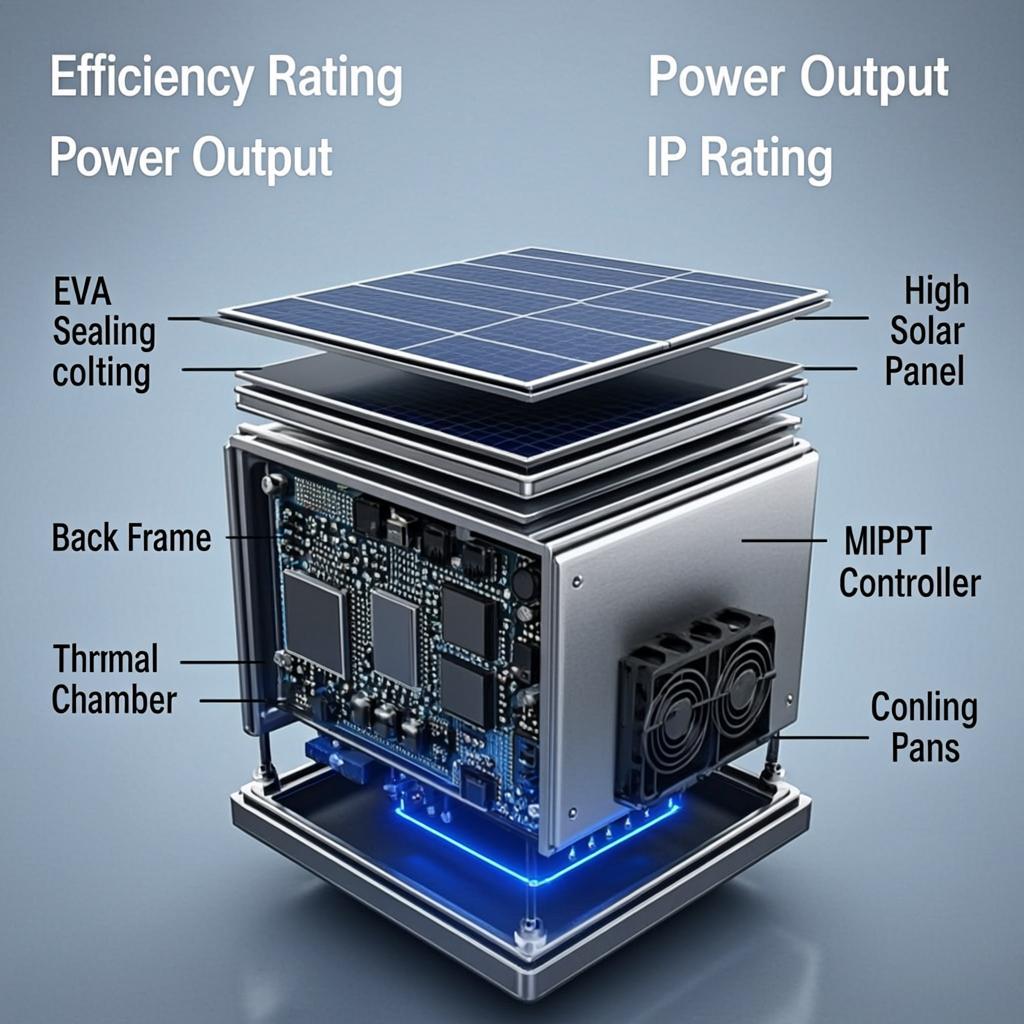
half cell solar panel vs full cell
In the evolving landscape of photovoltaic (PV) technology, the choice between half cell solar panel vs full cell configurations is pivotal for industrial buyers seeking maximum efficiency and
Half Cell Solar Panel vs Full Cell: Expert Comparison for Optimal PV Performance
1. Product Overview
In the evolving landscape of photovoltaic (PV) technology, the choice between half cell solar panel vs full cell configurations is pivotal for industrial buyers seeking maximum efficiency and reliability. Full cell solar panels, the traditional standard, utilize complete 210mm or 182mm silicon cells to deliver robust power output in uniform sunlight conditions. Conversely, half cell solar panels innovate by precisely cutting these full cells into two equal halves, typically 105mm or 91mm each, and interconnecting them in a series-parallel arrangement.
This half cell solar panel vs full cell comparison reveals key distinctions: half cell designs minimize resistive losses by shortening current paths, enhancing shade tolerance, and improving overall module performance. With global demand surging for high-efficiency PV solutions, half cell panels have gained traction, offering up to 2-3% higher energy yields in real-world scenarios compared to full cell counterparts. Ideal for commercial and utility-scale projects, understanding these differences empowers B2B procurement decisions, ensuring alignment with specific site conditions, budget constraints, and long-term ROI expectations.
Our portfolio encompasses both technologies, allowing clients to navigate the half cell solar panel vs full cell dilemma with data-driven insights. Backed by rigorous testing under IEC 61215 standards, these modules deliver proven durability and performance across diverse climates.
2. Key Features
Half Cell Solar Panels
- Reduced Inter-Cell Losses: Half-cut cells halve the current flow distance, cutting power losses by up to 75% compared to full cell designs.
- Superior Shade Tolerance: Independent upper and lower halves minimize shading impact, maintaining output even under partial obstruction.
- Higher Efficiency: Bifacial options achieve up to 22.5% module efficiency with advanced PERC or TOPCon cell tech.
- Mechanical Reliability: Fewer busbars and optimized ribbon design reduce micro-cracks and hotspots.
- Aesthetic Appeal: Multi-busbar (MBB) patterns for sleeker visuals, suitable for commercial rooftops.
Full Cell Solar Panels
- Proven Scalability: Larger cell format supports high-wattage modules (up to 600W+), ideal for ground-mounted arrays.
- Cost-Effective Production: Simpler manufacturing processes yield competitive pricing for bulk orders.
- Robust Power Density: Uniform full cells excel in open-field installations with consistent irradiance.
- Wide Compatibility: Seamless integration with legacy inverters and mounting systems.
- Durability in Harsh Conditions: Reinforced frames withstand high winds and snow loads up to 5400Pa.
When evaluating half cell solar panel vs full cell, half cell variants prioritize performance in constrained spaces, while full cell options emphasize economy at scale.
3. Technical Specifications
| Parameter | Half Cell Solar Panel (Typical 550W) | Full Cell Solar Panel (Typical 550W) |
|---|---|---|
| Cell Type | Monocrystalline Half-Cut, 182mm x 91mm (144 half cells) | Monocrystalline Full-Cut, 182mm x 182mm (108 full cells) |
| Maximum Power (Pmax) | 550W | 550W |
| Module Efficiency | 21.3% - 22.5% | 20.5% - 21.5% |
| Open Circuit Voltage (Voc) | 49.5V | 41.2V |
| Short Circuit Current (Isc) | 14.25A | 17.00A |
| Dimensions (L x W x H) | 2278 x 1134 x 35mm | 2278 x 1134 x 35mm |
| Weight | 27.5kg | 28.2kg |
| Temperature Coefficient (Pmax) | -0.34%/°C | -0.35%/°C |
| Maximum System Voltage | 1500V DC | 1500V DC |
| Wind/Snow Load | 2400Pa / 5400Pa | 2400Pa / 5400Pa |
| Warranty | 12 years product / 30 years linear power | 12 years product / 30 years linear power |
| Certifications | UL, IEC, CE, TUV | UL, IEC, CE, TUV |
This table underscores the nuances in half cell solar panel vs full cell specs, with half cell models showing advantages in voltage stability and efficiency.
4. Application Scenarios
The half cell solar panel vs full cell decision hinges on deployment context. Half cell panels thrive in urban rooftops, carports, and agrivoltaic setups where shading from chimneys, trees, or panels is common. Their segmented design ensures minimal production dips—up to 50% less loss under partial shade—making them perfect for commercial buildings aiming for high specific yields.
Full cell panels dominate utility-scale solar farms and desert installations with unobstructed sunlight. Their higher current output simplifies string design, reducing BOS (balance of system) costs in large arrays exceeding 100MW. In floating PV or bifacial ground mounts, full cells leverage reflective gains effectively.
Hybrid projects often blend both: half cells for shaded edges, full cells for core fields, optimizing the half cell solar panel vs full cell balance for tailored energy harvesting.
5. Advantages
Delving deeper into half cell solar panel vs full cell, half cell technology offers multifaceted benefits. By bisecting cells, resistive losses plummet from I²R effects, boosting low-light performance by 5-10%. Mechanical stress during transportation and installation is halved, extending lifespan beyond 30 years with <0.55%/year degradation.
Full cell panels counter with manufacturing simplicity, achieving 0.5-1% lower costs per watt—crucial for hyperscale deployments. They also exhibit superior bifaciality factors (70-80%) in open terrains, capturing albedo for extra 10-30% gains.
Overall, half cells edge out in PID resistance and hot-spot mitigation, while full cells prioritize raw power density. Empirical data from PVEL scorecard confirms both excel, but half cells lead in field reliability metrics.
6. Why Choose Us
As a tier-1 manufacturer with 15+ years in PV, we demystify half cell solar panel vs full cell through customized solutions. Our state-of-the-art facilities in Southeast Asia produce over 5GW annually, adhering to ISO 9001 and REACH standards. We offer bankable performance guarantees, rapid lead times (4-6 weeks), and flexible MOQs from 100kW.
Our R&D team pioneers N-type half cell innovations, delivering 25%+ efficiencies ahead of market curves. With global logistics to 50+ countries, we provide lifecycle support—from simulation modeling to O&M. Choosing us means unbiased guidance on half cell solar panel vs full cell, backed by audited supply chains and zero-compromise quality.
7. FAQ
Q: What is the main difference in half cell solar panel vs full cell performance?
A: Half cell panels reduce current mismatch and shading losses by 2-5%, yielding higher annual kWh in non-ideal conditions.
Q: Are half cell panels more expensive than full cell?
A: Initially 3-5% higher due to cutting processes, but LCOE parity or better via superior energy harvest.
Q: Can I mix half cell and full cell in the same array?
A: Yes, with compatible Voc/Isc; consult string design to avoid mismatch penalties.
Q: How does temperature affect half cell solar panel vs full cell?
A: Half cells maintain slight edge with lower operating temps from reduced resistance.
Q: What warranties apply?
A: Standard 12/30 years; extended options for premium half cell lines.
Q: Are half cell panels future-proof?
A: Absolutely—scalable to HJT and BC architectures, aligning with net-zero trajectories.
Related product
- English
- Françai
- Español
- Deutsch
- Română
- العربية
- 한국어
- 日本語
- Italiano
- Português
- Gaeilge
- Dansk
- Čeština
- Русский
- Afrikaans
- Euskara
- Català
- Esperanto
- हिन्दी
- Ελληνικά
- Bahasa Melayu
- Polski
- Српски
- Kiswahili
- ภาษาไทย
- Tiếng Việt
- Türkçe
- Svenska
- Cymraeg
- Slovenčina
- Latviešu
- Malti
- Magyar
- Galego
- ગુજરાતી
- Eesti Keel
- বাংলা
- Shqip
- беларуская мова
- Nederlands
- Tagalog
- ქართული
- Íslenska
- Kreyòl Ayisyen
- Lietuvių
- Norsk
- slovenščina
- தமிழ்
- Українська
- ײִדיש
- اردو
- తెలుగు
- فارسی
- македонски
- ಕನ್ನಡ
- Bahasa Indonesia
- עברית
- Suomi
- Hrvatski
- Български
- Azerbaijani