

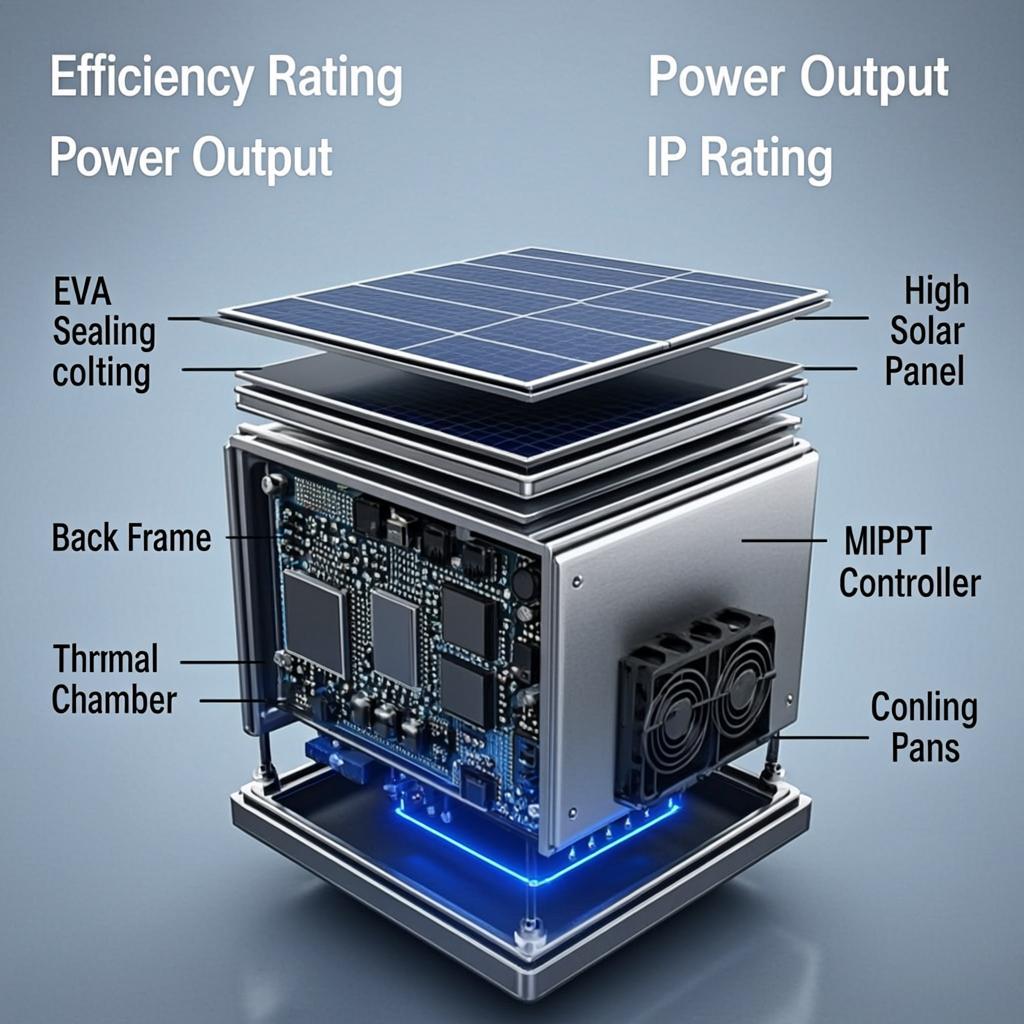
half cell solar panel meaning
In the evolving landscape of renewable energy, understanding the half cell solar panel meaning is crucial for businesses seeking cutting-edge photovoltaic solutions. Half-cell solar panels represent
Half Cell Solar Panel Meaning: Revolutionizing Solar Efficiency
1. Product Overview
In the evolving landscape of renewable energy, understanding the half cell solar panel meaning is crucial for businesses seeking cutting-edge photovoltaic solutions. Half-cell solar panels represent an advanced iteration of traditional solar modules, where standard silicon solar cells are precisely bisected into two equal halves. This innovative design fundamentally enhances performance by minimizing electrical losses and optimizing power output under real-world conditions.
The half cell solar panel meaning extends beyond mere physical division; it embodies a strategic engineering approach that addresses key limitations of full-cell panels. By halving the cell size, current flow through each cell is reduced by approximately 50%, which in turn slashes resistive losses (I²R losses) significantly. This results in higher efficiency rates, often exceeding 20-22% module efficiency, making them ideal for commercial and industrial applications where space and performance are paramount.
Manufactured using high-quality monocrystalline or polycrystalline silicon, half-cell panels maintain the durability and reliability of conventional modules while introducing superior shading tolerance and lower temperature coefficients. For international traders and B2B buyers, grasping the half cell solar panel meaning unlocks opportunities to procure modules that deliver superior ROI through extended energy yield and reduced levelized cost of electricity (LCOE).
These panels are typically assembled with 120, 144, or more half-cells, configured in series-parallel arrangements (e.g., 6x20 or 6x24 layouts), ensuring balanced power distribution. Certifications like IEC 61215, IEC 61730, and UL 1703 underscore their compliance with global standards, providing peace of mind for exporters and importers alike.
2. Key Features
- Reduced Resistive Losses: Half-cell configuration cuts current in half, minimizing I²R losses by up to 75% compared to full-cell panels.
- Enhanced Shading Tolerance: Independent half-cell operation prevents shading on one half from affecting the entire cell, boosting overall yield by 5-10%.
- Lower Temperature Coefficient: Improved heat dissipation leads to a reduced power drop (typically -0.35%/°C), ideal for hot climates.
- High Efficiency: Module efficiencies up to 22.5%, leveraging advanced PERC or TOPCon cell technologies.
- Robust Construction: Tempered glass (3.2mm), anodized aluminum frames, and IP68 junction boxes for superior weather resistance.
- Multi-Busbar (MBB) Technology: Integrated for further loss reduction and better light trapping.
- Easy Integration: Compatible with standard racking systems and inverters, simplifying large-scale deployments.
These features collectively define the half cell solar panel meaning in practical terms: a leap forward in solar technology tailored for demanding B2B environments.
3. Technical Specifications
| Parameter | Value | Unit | Notes |
|---|---|---|---|
| Module Type | Half-Cell Monocrystalline PERC | - | 144 half-cells (72 full-cell equivalent) |
| Maximum Power (Pmax) | 550-580 | W | STC conditions |
| Module Efficiency | 21.3-22.5 | % | Advanced cell tech |
| Open Circuit Voltage (Voc) | 49.5-50.5 | V | Per module |
| Short Circuit Current (Isc) | 14.2-14.8 | A | Reduced due to half-cells |
| Maximum System Voltage | 1500 | DC V | Compatible with high-voltage systems |
| Temperature Coefficient (Pmax) | -0.35 | %/°C | Superior to full-cell panels |
| Dimensions (L x W x H) | 2278 x 1134 x 35 | mm | Standard M10 wafer size |
| Weight | 27.5 | kg | Lightweight for easy handling |
| Front Glass | 3.2mm Tempered, AR Coated | - | High transmission rate >91.5% |
| Junction Box | IP68 Rated, 3 Diodes | - | Bypass diodes included |
| Warranty | 12 years product, 30 years linear power | - | First-year degradation <2%, annual <0.55% |
| Certifications | IEC 61215, IEC 61730, UL 1703, CE | - | Global compliance |
These specifications highlight the technical prowess behind the half cell solar panel meaning, ensuring reliability across diverse international markets.
4. Application Scenarios
Half-cell solar panels excel in a variety of B2B application scenarios, where the half cell solar panel meaning translates to tangible performance gains. In commercial rooftops, their shading tolerance shines in urban settings with partial obstructions from HVAC units or parapets, maintaining high output without string derating.
For ground-mounted utility-scale projects, the reduced BOS (balance of system) costs due to higher power density (up to 580W per panel) minimize land usage and racking expenses. Industrial parks benefit from their low-light performance, ensuring consistent energy harvest during cloudy periods common in manufacturing hubs.
In off-grid and hybrid systems for remote industrial sites, half-cell panels provide reliable power for pumps, lighting, and monitoring equipment. Floating solar farms leverage their lightweight design and corrosion resistance for water-based installations. Additionally, agrivoltaics—combining solar with agriculture—utilizes their elevated shading resilience to coexist with crop shading needs.
Export-oriented businesses will find these panels perfect for markets in Europe (feed-in tariffs), Asia (high irradiance), and the Middle East (extreme temperatures), embodying the full half cell solar panel meaning in scalable, high-yield deployments.
5. Advantages
The advantages of half-cell solar panels are rooted in their core design, making the half cell solar panel meaning synonymous with superior value. Firstly, energy yield improvements of 2-5% over full-cell counterparts stem from halved ribbon resistance and optimized current paths, directly impacting LCOE.
Shading performance is unparalleled; tests show up to 80% less output loss when 1/6th of the panel is shaded. Mechanical load capacity exceeds 5400Pa front and 2400Pa rear, suitable for high-wind regions. Bifacial options further amplify gains by capturing rear-side albedo, adding 10-30% extra power.
From an economic standpoint, higher wattage per unit reduces installation labor by 20-30% and inverter clipping losses. Long-term reliability is assured with PID-free cells and anti-LID technology, guaranteeing 84.8% output after 30 years. For B2B procurement, these panels offer competitive pricing per watt, faster payback (typically 4-6 years), and seamless integration with trackers and optimizers.
In essence, embracing the half cell solar panel meaning equips your projects with future-proof technology that outperforms in efficiency, durability, and cost-effectiveness.
6. Why Choose Us
As a leading manufacturer in the solar industry, we specialize in half-cell solar panels that perfectly encapsulate the half cell solar panel meaning through precision engineering and quality control. Our state-of-the-art facilities boast automated production lines with >99% cell cutting accuracy, utilizing laser scribing for minimal microcracks.
We source Tier 1 silicon wafers and EVA encapsulants, ensuring batch-to-batch consistency verified by third-party testing (TUV, SGS). With annual capacity exceeding 5GW, we cater to bulk B2B orders with flexible MOQs, OEM/ODM services, and customized branding for international trade.
Our global supply chain minimizes lead times (4-6 weeks), supported by ISO 9001, ISO 14001, and OHSAS 18001 certifications. We provide comprehensive technical support, including shade analysis simulations and system design consultations. Partnering with us means accessing panels that deliver on the promise of half cell solar panel meaning—innovation backed by performance data and unwavering reliability.
7. FAQ
What is the half cell solar panel meaning?
The half cell solar panel meaning refers to solar modules where full-sized cells are cut into two halves, reducing current flow, resistive losses, and improving shading tolerance and efficiency.
How do half-cell panels differ from full-cell panels?
Half-cell panels halve the cell dimensions, lowering series resistance and enabling better mismatch tolerance, resulting in 2-5% higher annual energy yield.
Are half-cell solar panels more efficient?
Yes, they typically achieve 21-22.5% efficiency due to reduced losses and advanced technologies like PERC and MBB.
What is the lifespan of half-cell solar panels?
Backed by 30-year linear power warranties, they retain >84% output, with robust construction for 25+ years of service.
Do half-cell panels perform better in shade?
Absolutely; bypass diodes per half-cell segment minimize shading-induced losses, outperforming full-cell designs by up to 10%.
Are they suitable for all climates?
Yes, with low temperature coefficients and PID resistance, they excel in hot, cold, humid, or dusty environments.
Related product
- English
- Françai
- Español
- Deutsch
- Română
- العربية
- 한국어
- 日本語
- Italiano
- Português
- Gaeilge
- Dansk
- Čeština
- Русский
- Afrikaans
- Euskara
- Català
- Esperanto
- हिन्दी
- Ελληνικά
- Bahasa Melayu
- Polski
- Српски
- Kiswahili
- ภาษาไทย
- Tiếng Việt
- Türkçe
- Svenska
- Cymraeg
- Slovenčina
- Latviešu
- Malti
- Magyar
- Galego
- ગુજરાતી
- Eesti Keel
- বাংলা
- Shqip
- беларуская мова
- Nederlands
- Tagalog
- ქართული
- Íslenska
- Kreyòl Ayisyen
- Lietuvių
- Norsk
- slovenščina
- தமிழ்
- Українська
- ײִדיש
- اردو
- తెలుగు
- فارسی
- македонски
- ಕನ್ನಡ
- Bahasa Indonesia
- עברית
- Suomi
- Hrvatski
- Български
- Azerbaijani