

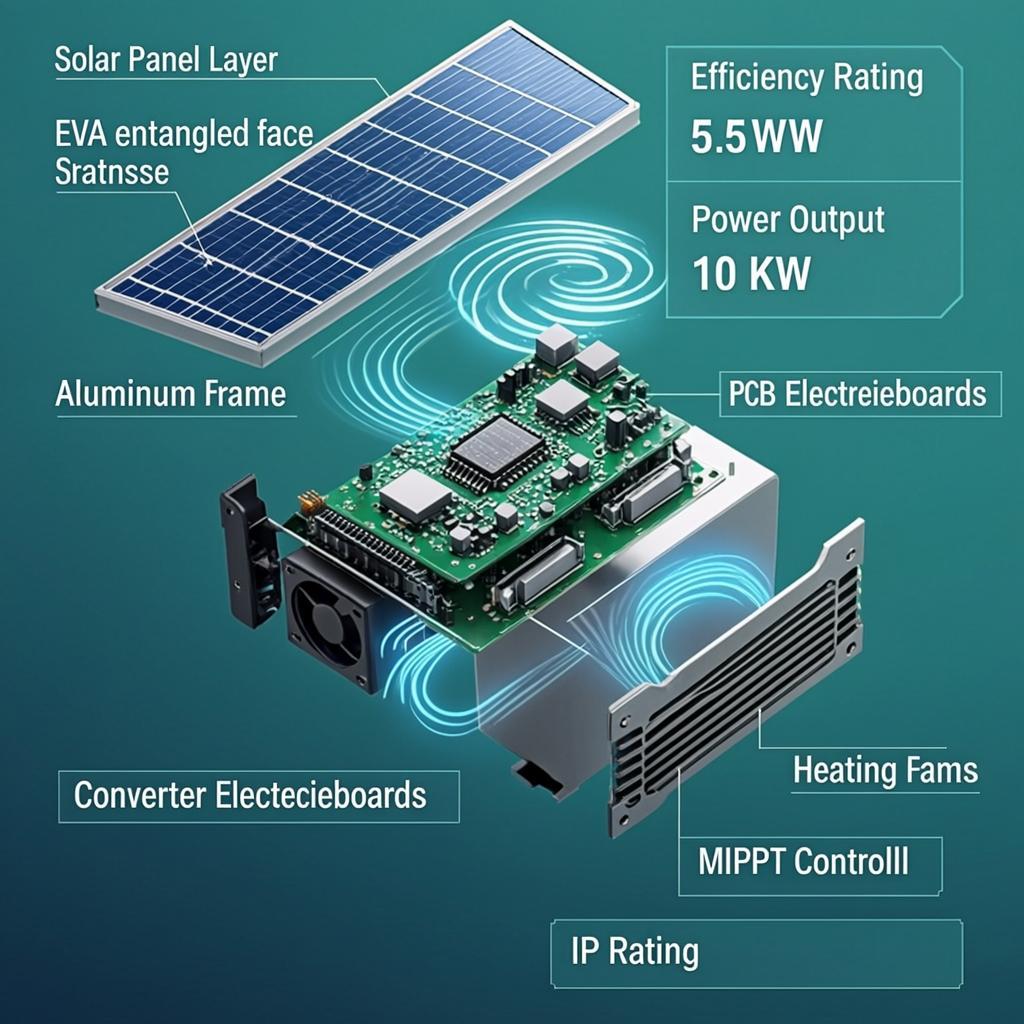
bifacial solar panels
Our bifacial solar panels represent the pinnacle of photovoltaic technology, designed to capture sunlight from both the front and rear surfaces for maximum energy yield. Unlike traditional monofacial
Bifacial Solar Panels
Product Overview
Our bifacial solar panels represent the pinnacle of photovoltaic technology, designed to capture sunlight from both the front and rear surfaces for maximum energy yield. Unlike traditional monofacial panels, bifacial solar panels utilize reflected and diffused light from the ground, surrounding surfaces, and even snow, boosting overall performance by up to 30% in optimal conditions. Engineered for commercial and industrial applications, these panels deliver superior efficiency, durability, and return on investment, making them ideal for international trade and large-scale solar projects worldwide.
Manufactured with cutting-edge PERC (Passivated Emitter and Rear Cell) or TOPCon (Tunnel Oxide Passivated Contact) cell technology, our bifacial solar panels achieve efficiencies exceeding 22%, ensuring reliable power generation even in challenging environments. Whether deployed in ground-mounted solar farms, rooftop installations, or floating solar systems, these panels offer unmatched bifaciality ratios of 70-85%, translating to higher kilowatt-hour outputs per installed watt. Backed by rigorous testing and international certifications such as IEC 61215, IEC 61730, and UL 61730, our bifacial solar panels are built to withstand extreme weather, from high winds to heavy snow loads, providing long-term reliability for B2B partners seeking sustainable energy solutions.
In the evolving landscape of renewable energy, bifacial solar panels stand out for their versatility and performance advantages. They excel in high-albedo environments like white gravel fields or reflective roofs, where rear-side generation significantly enhances total output. For importers, distributors, and EPC contractors, our bifacial solar panels provide a competitive edge through scalable production, customizable configurations, and competitive pricing tailored to global markets.
Key Features
- High Bifaciality: 70-85% bifaciality factor enables energy capture from both sides, maximizing yield in diverse installations.
- Advanced Cell Technology: Utilizes N-type TOPCon or HJT cells for efficiencies up to 23%, with low LID (Light Induced Degradation) and PID (Potential Induced Degradation) resistance.
- Robust Frame Design: Anodized aluminum alloy frame with reinforced corners, supporting wind loads up to 5400 Pa and snow loads up to 5400 Pa.
- Anti-Reflective Glass: Dual-glass or tempered glass options with AR coating on both sides for optimal light transmission and self-cleaning properties.
- Excellent Low-Light Performance: Maintains high efficiency from dawn to dusk and in cloudy conditions, ideal for regions with variable irradiance.
- Long-Term Reliability: 30-year linear power warranty with first-year degradation <2% and annual degradation <0.55% thereafter.
- Easy Integration: Compatible with major trackers, inverters, and mounting systems; available in half-cut and multi-busbar designs for reduced shading losses.
- Environmental Compliance: RoHS compliant, recyclable materials, and salt mist & ammonia corrosion resistance for coastal and agrivoltaic applications.
Technical Specifications
| Parameter | Value |
|---|---|
| Module Type | Bifacial Glass/Glass or Glass/Backsheet |
| Power Range | 550W - 700W |
| Maximum Efficiency | Up to 23% |
| Bifaciality | 70-85% |
| Cell Type | N-type TOPCon / HJT, 182mm or 210mm half-cut |
| Number of Cells | 132 / 144 / 156 |
| Dimensions (L x W x H) | 2382 x 1134 x 30mm / 2465 x 1134 x 30mm |
| Weight | 31.8 - 34.5 kg |
| Front Glass | 2.0mm tempered glass with AR coating |
| Rear Glass | 2.0mm tempered glass |
| Frame | Anodized silver aluminum alloy |
| Junction Box | IP68 rated, 3 diodes |
| Cable | 4mm², length 1400mm (+/-) / 350mm (+/-) |
| Connectors | MC4 compatible |
| Maximum System Voltage | 1500V DC |
| Operating Temperature | -40°C to +85°C |
| Maximum Wind Load | 2400 Pa |
| Maximum Snow Load | 5400 Pa |
| Warranty | 15-year product / 30-year linear power output |
| Certifications | IEC 61215, IEC 61730, UL 61730, CE, INMETRO |
Note: Specifications subject to final datasheet; custom configurations available for bulk orders.
Application Scenarios
Bifacial solar panels thrive in a wide array of commercial and utility-scale deployments, leveraging their dual-sided energy capture for optimized performance. In ground-mounted solar farms on reflective terrains such as deserts or white-pebble fields, bifacial solar panels can increase energy production by 15-30% compared to monofacial alternatives, making them a top choice for large EPC projects in regions like the Middle East, Australia, and the southwestern United States.
For commercial rooftops with light-colored membranes or metal surfaces, these panels excel by harnessing albedo reflections, ideal for warehouses, factories, and office buildings aiming for net-zero energy goals. In agrivoltaics—dual-use systems combining solar generation with agriculture—bifacial solar panels allow shade-tolerant crops to grow beneath elevated arrays, enhancing land efficiency in Europe and Asia's rural landscapes.
Floating solar installations benefit from water's high reflectivity, where bifacial solar panels mounted on pontoons deliver superior yields in reservoirs and hydropower sites across Southeast Asia and South America. Snow-rich environments, such as alpine regions in North America and Scandinavia, see amplified rear-side generation from snow cover, extending operational hours. Additionally, bifacial solar panels integrate seamlessly with single-axis trackers in utility-scale parks, maximizing ROI through higher capacity factors and faster payback periods.
Advantages
The advantages of bifacial solar panels extend far beyond conventional PV modules, offering tangible benefits for B2B stakeholders in international trade. Foremost is the elevated energy yield: with bifaciality enabling 10-30% more kWh per kWp, projects achieve shorter levelized cost of energy (LCOE) and quicker grid parity. This is particularly pronounced in high-reflection setups, where rear-side contribution can exceed 20% of total output.
Durability is another cornerstone; glass-glass encapsulation provides superior resistance to microcracks, moisture ingress, and UV degradation, ensuring <1% first-year degradation and minimal annual loss. Low temperature coefficients further enhance performance in hot climates, outperforming monofacial panels by maintaining output under high irradiance.
Economically, bifacial solar panels reduce BOS (balance of system) costs through higher power density—fewer modules for the same capacity mean less racking, wiring, and labor. Their versatility supports innovative designs like vertical bifacial setups for carports and noise barriers, expanding market opportunities. Environmentally, extended lifespans and recyclability align with ESG mandates, appealing to institutional investors and green procurement policies worldwide.
Why Choose Us
As a leading manufacturer of bifacial solar panels, we combine decades of expertise with state-of-the-art production lines exceeding 10GW annual capacity. Our panels undergo automated stringing, laser welding, and electroluminescence testing for zero-defect quality, certified by TUV, UL, and CSA. We prioritize supply chain transparency with Tier 1 silicon sourcing, ensuring stable delivery for global projects.
Customization is key: from tailored power bins to project-specific certifications, we support OEM/ODM partners with rapid prototyping and flexible MOQs. Our R&D team continually innovates, incorporating multi-busbar and shingled cell tech to push bifacial efficiencies higher. Competitive ex-works pricing, combined with containerized logistics to major ports, minimizes landed costs for importers in Europe, Americas, and APAC.
Customer-centric service includes third-party inspections, extended warranties, and performance analytics via IoT monitoring. Trusted by Fortune 500 utilities and top EPC firms, we deliver not just bifacial solar panels, but proven partnerships driving renewable energy transitions.
FAQ
What are bifacial solar panels?
Bifacial solar panels generate power from both front and back sides, using direct sunlight on the front and reflected light on the rear for higher total output.
How much extra energy do bifacial solar panels produce?
Gains typically range from 5-30%, depending on installation height, ground albedo, and tilt angle. Optimal setups with trackers and reflective surfaces yield the most.
Are bifacial solar panels suitable for all installations?
Yes, but they shine in ground-mount, elevated, or reflective environments. For flat roofs, ensure sufficient rear-side exposure.
What is the bifaciality factor?
It measures rear-side performance relative to the front, usually 70-85% for our panels, verified under standard test conditions.
Do bifacial solar panels require special mounting?
No, they are compatible with standard racking, but elevated designs (0.5-1m height) maximize rear irradiation.
What warranties are offered?
15 years on product workmanship and 30 years on linear power output, with performance guarantees backed by insurance.
Are they resistant to harsh environments?
Absolutely—tested for salt mist, ammonia, fire (Class C), and extreme loads, perfect for marine, farm, and desert deployments.
How do bifacial solar panels perform in low light?
Excellent, thanks to advanced cells and AR glass; they maintain 90-95% relative efficiency at 200W/m² irradiance.
Related product
- English
- Françai
- Español
- Deutsch
- Română
- العربية
- 한국어
- 日本語
- Italiano
- Português
- Gaeilge
- Dansk
- Čeština
- Русский
- Afrikaans
- Euskara
- Català
- Esperanto
- हिन्दी
- Ελληνικά
- Bahasa Melayu
- Polski
- Српски
- Kiswahili
- ภาษาไทย
- Tiếng Việt
- Türkçe
- Svenska
- Cymraeg
- Slovenčina
- Latviešu
- Malti
- Magyar
- Galego
- ગુજરાતી
- Eesti Keel
- বাংলা
- Shqip
- беларуская мова
- Nederlands
- Tagalog
- ქართული
- Íslenska
- Kreyòl Ayisyen
- Lietuvių
- Norsk
- slovenščina
- தமிழ்
- Українська
- ײִדיש
- اردو
- తెలుగు
- فارسی
- македонски
- ಕನ್ನಡ
- Bahasa Indonesia
- עברית
- Suomi
- Hrvatski
- Български
- Azerbaijani