

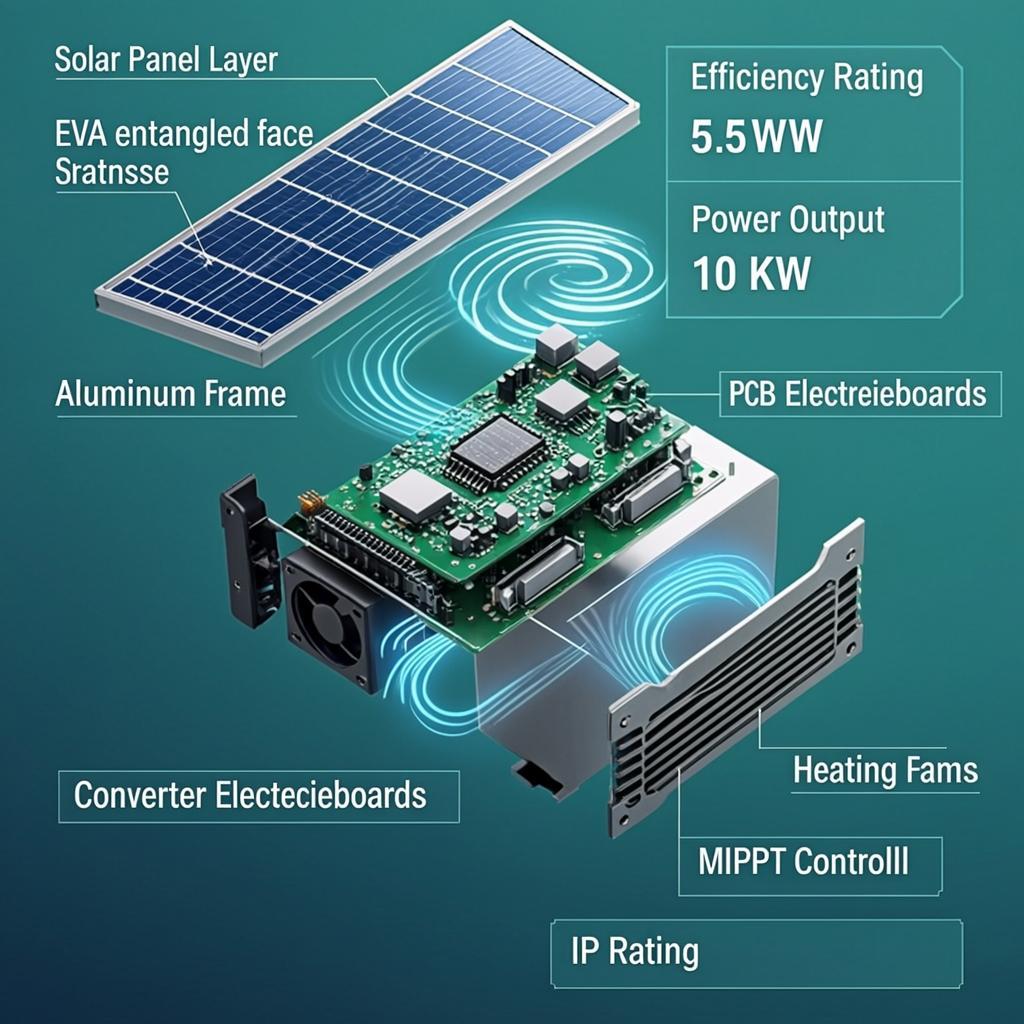
bifacial solar panel technology
Discover the future of renewable energy with our advanced bifacial solar panel technology. Unlike traditional monofacial panels that capture sunlight only from the front side, bifacial solar panel
Bifacial Solar Panel Technology
Product Overview
Discover the future of renewable energy with our advanced bifacial solar panel technology. Unlike traditional monofacial panels that capture sunlight only from the front side, bifacial solar panel technology harnesses solar irradiance from both the front and rear surfaces, significantly boosting overall energy production. This innovative approach utilizes high-performance N-type TOPCon or HJT cells, combined with dual-glass encapsulation, to achieve superior bifaciality factors of up to 80%.
Engineered for the demands of international trade and large-scale deployments, our bifacial solar panels deliver power outputs ranging from 550W to 700W per module. Ideal for utility-scale projects, commercial installations, and industrial applications, this technology maximizes land use efficiency and reduces levelized cost of energy (LCOE). Backed by rigorous testing and compliance with IEC 61215 and IEC 61730 standards, our bifacial solar panel technology ensures long-term reliability in diverse climates, from arid deserts to snowy highlands. By reflecting and diffusing albedo from the ground—such as white gravel, snow, or water surfaces—these panels can generate 10-30% more energy annually compared to conventional alternatives, making them a cornerstone for sustainable energy strategies worldwide.
Key Features
- High Bifaciality: Up to 80% bifaciality ratio, enabling optimal rear-side energy capture with bifacial solar panel technology.
- Advanced Cell Architecture: Utilizes N-type TOPCon or HJT cells for minimized light-induced degradation (LID) and superior low-light performance.
- Dual-Glass Design: Tempered glass on both sides for enhanced mechanical load resistance up to 5400Pa front and 2400Pa rear.
- Low Degradation Rate: First-year degradation <1%, annual <0.4%, ensuring 30+ years of peak performance.
- Anti-PID and Anti-Snail Trail: Robust protection against potential induced degradation and microcracks.
- Optimized Frame and Junction Box: Anodized aluminum frame with IP68-rated junction box for harsh environmental resilience.
- Certifications: TUV, UL, CE, and INMETRO certified, compliant with global bifacial solar panel technology standards.
Technical Specifications
| Parameter | Value |
|---|---|
| Module Type | Bifacial Glass-Glass (72 cells) |
| Maximum Power (Pmax) Front Side | 600W - 700W |
| Bifaciality | 70-80% |
| Module Efficiency (Front Side) | Up to 22.5% |
| Dimensions (L x W x H) | 2382 x 1134 x 30mm |
| Weight | 32.5kg ± 0.5kg |
| Cell Type | N-type TOPCon / HJT |
| Front Glass | 2.0mm tempered glass |
| Rear Glass | 2.0mm tempered glass |
| Frame | Anodized aluminum alloy |
| Junction Box | IP68 rated, 3 diodes |
| Cable | 4mm², length 1400mm (+/-50mm) |
| Connectors | MC4 compatible |
| Maximum System Voltage | 1500V DC |
| Operating Temperature | -40°C to +85°C |
| Mechanical Load | 5400Pa front / 2400Pa rear |
| Hail Test | 35mm hailstone at 97km/h |
| Warranty | 12 years product / 30 years linear power |
| Certifications | IEC 61215, IEC 61730, UL 61730, CE |
Application Scenarios
Bifacial solar panel technology excels in a variety of real-world deployments, leveraging its dual-sided light absorption for maximized yields. In utility-scale ground-mounted systems, panels are elevated on trackers or fixed tilts over reflective surfaces like white pebbles or TPO membranes, yielding up to 25% higher output. For commercial rooftops, especially on flat or white-reflective roofs, bifacial modules outperform monofacial counterparts by capturing bounced light from surrounding structures.
Agrivoltaics represents another prime scenario, where bifacial solar panel technology integrates with agriculture—panels mounted higher allow crops like berries or lettuce to grow underneath, utilizing the shaded, cooler environment while generating power. Floating solar farms on reservoirs benefit immensely, as water's high albedo (up to 20%) boosts rear-side generation by 15-30%. In harsh environments such as deserts or polar regions, the technology's snow-reflection capabilities and dust resistance ensure consistent performance. Additionally, bifacial panels suit carports and canopies, enhancing urban energy harvesting with minimal footprint. These versatile applications underscore why bifacial solar panel technology is pivotal for global energy transitions.
Advantages
The advantages of bifacial solar panel technology are rooted in its physics and engineering excellence. Primarily, it offers enhanced energy yield: by capturing diffuse and reflected light, panels produce 10-30% more kWh per square meter, shortening payback periods and improving ROI for B2B clients. Superior durability comes from the glass-glass construction, which resists PID, LID, and thermomechanical stress better than backsheet modules, with proven salt mist and ammonia resistance for coastal or farming-adjacent sites.
Financially, bifacial solar panel technology lowers LCOE through higher specific production and reduced BOS costs—fewer modules needed for the same capacity. Environmentally, it promotes bifaciality in dual-use land applications, preserving arable soil while accelerating decarbonization. Performance in non-optimal conditions shines: low irradiance mornings, evenings, or cloudy days see amplified gains from rear-side contribution. Longevity is assured with warranties up to 30 years at 87% output, minimizing Opex. Compared to monofacial peers, bifacial modules exhibit lower temperature coefficients, mitigating heat-related losses. In essence, investing in bifacial solar panel technology equips businesses with a competitive edge in the evolving PV market.
Why Choose Us
As a leading manufacturer specializing in bifacial solar panel technology, we deliver unmatched value through vertical integration—from silicon ingot to module assembly. Our state-of-the-art facilities employ automated lines adhering to Six Sigma quality control, ensuring batch-to-batch consistency. We offer customization options, including tailored power ratings, dimensions, and branding for OEM partners in international trade.
Global supply chain reliability is our hallmark: Tier 1 banks financing, A-grade polysilicon sourcing, and logistics optimized for exports to Europe, Americas, Asia-Pacific, and MENA regions. Rigorous third-party validations like DNV GL EL2 fire rating and salt corrosion testing (IEC 61701) affirm our panels' bankability. With over 10GW shipped annually, we support hyperscale projects with flexible MOQs and just-in-time delivery. Our R&D team continually advances bifacial solar panel technology, incorporating AI-optimized cell passivation for next-gen efficiencies. Partner with us for transparent pricing, comprehensive technical support, and a commitment to mutual growth in the renewable sector.
FAQ
What is bifacial solar panel technology?
Bifacial solar panel technology refers to photovoltaic modules that generate electricity from both front and back sides, leveraging reflected light (albedo) for increased output.
How much more energy do bifacial panels produce?
Typically 10-30% more than monofacial panels, depending on installation height, ground reflectivity, and tilt angle.
Are bifacial panels suitable for all installations?
Best for ground-mount, elevated, or reflective surface setups; less ideal for low-height or dark-roof applications.
What maintenance do they require?
Minimal—self-cleaning glass reduces dust accumulation; periodic inspections for trackers recommended.
Do they come with performance warranties?
Yes, 30 years linear power warranty, guaranteeing at least 84.95% output after 30 years.
Are your panels compatible with existing inverters?
Fully compatible with standard string inverters; bifacial gain is automatically realized without reconfiguration.
What albedo surfaces maximize bifacial gains?
White gravel (70-80%), fresh snow (90%), water (10-20%), or bright concrete.
Related product
- English
- Françai
- Español
- Deutsch
- Română
- العربية
- 한국어
- 日本語
- Italiano
- Português
- Gaeilge
- Dansk
- Čeština
- Русский
- Afrikaans
- Euskara
- Català
- Esperanto
- हिन्दी
- Ελληνικά
- Bahasa Melayu
- Polski
- Српски
- Kiswahili
- ภาษาไทย
- Tiếng Việt
- Türkçe
- Svenska
- Cymraeg
- Slovenčina
- Latviešu
- Malti
- Magyar
- Galego
- ગુજરાતી
- Eesti Keel
- বাংলা
- Shqip
- беларуская мова
- Nederlands
- Tagalog
- ქართული
- Íslenska
- Kreyòl Ayisyen
- Lietuvių
- Norsk
- slovenščina
- தமிழ்
- Українська
- ײִדיש
- اردو
- తెలుగు
- فارسی
- македонски
- ಕನ್ನಡ
- Bahasa Indonesia
- עברית
- Suomi
- Hrvatski
- Български
- Azerbaijani