

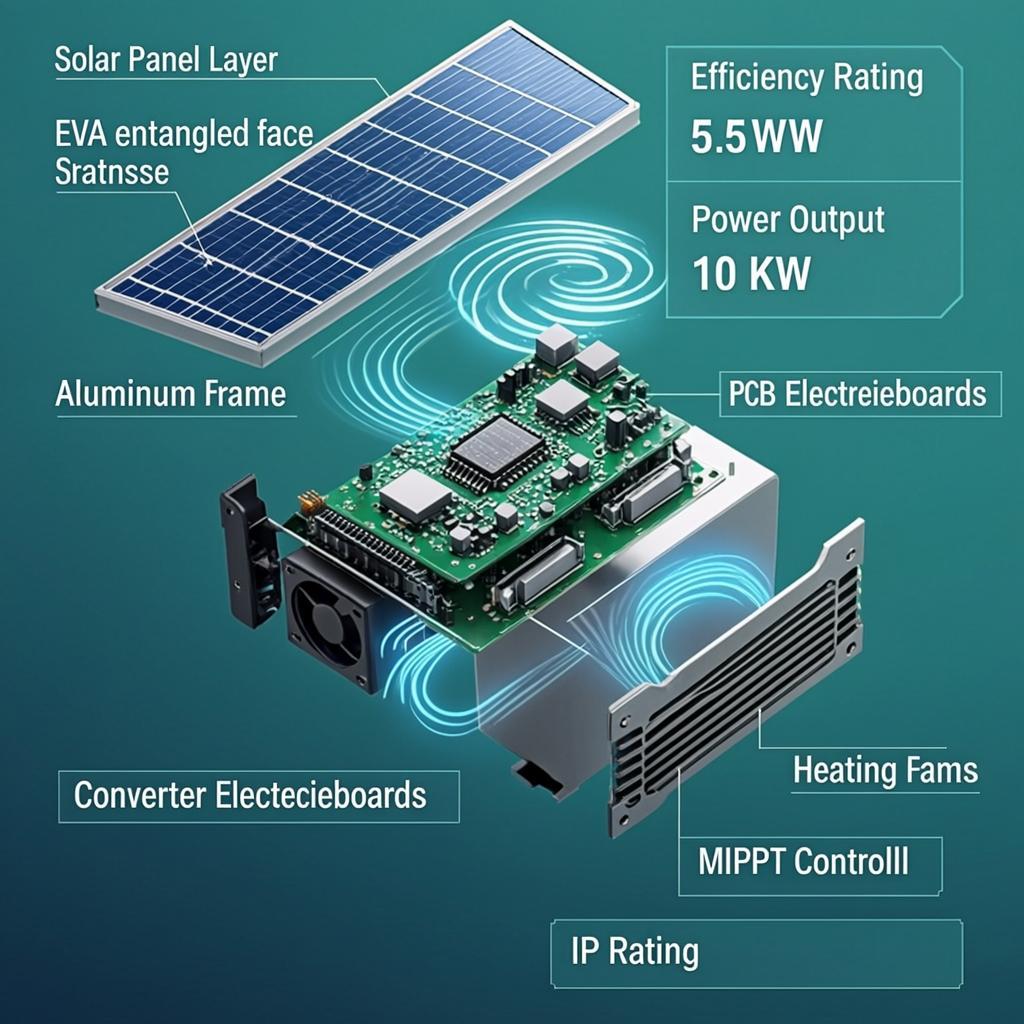
bifacial solar cells
Our bifacial solar cells represent the pinnacle of photovoltaic innovation, designed to capture sunlight from both the front and rear surfaces for maximum energy yield. Unlike traditional monofacial
Bifacial Solar Cells
Product Overview
Our bifacial solar cells represent the pinnacle of photovoltaic innovation, designed to capture sunlight from both the front and rear surfaces for maximum energy yield. Unlike traditional monofacial solar cells, bifacial solar cells utilize reflected and diffused light from the ground, surrounding surfaces, and even the atmosphere, boosting overall efficiency by up to 30% in optimal installations. These cells are engineered with high-purity N-type silicon wafers, advanced passivation layers, and silver-free metallization to ensure superior performance and longevity.
Ideal for international trade and large-scale B2B deployments, our bifacial solar cells achieve front-side efficiencies exceeding 24% and bifaciality factors above 80%, making them a preferred choice for utility-scale projects, commercial rooftops, and innovative applications like agrivoltaics. By harnessing albedo effects—where ground reflectivity enhances rear-side generation—bifacial solar cells deliver higher energy production per unit area, lower levelized cost of energy (LCOE), and faster return on investment. Our manufacturing process adheres to stringent international standards, including IEC 61215 and IEC 61730 certifications, ensuring reliability in diverse climates from deserts to snowy regions.
With a focus on sustainability, these bifacial solar cells incorporate lead-free materials and recyclable components, aligning with global ESG goals. Whether you're sourcing for ground-mounted power plants or vertical installations, our bifacial solar cells provide unmatched versatility and performance, positioning your projects at the forefront of renewable energy adoption.
Key Features
- High Bifaciality: Greater than 80% bifaciality factor, enabling significant rear-side power generation from albedo and diffuse light.
- Advanced Efficiency: Front-side conversion efficiency up to 24.5%, with potential total yields 20-30% higher than monofacial alternatives.
- N-Type TOPCon Technology: Utilizes tunnel oxide passivated contact for reduced recombination losses and superior low-light performance.
- Robust Durability: PID-resistant (Potential Induced Degradation) and LID-free (Light Induced Degradation), with minimal degradation rates below 0.4% annually.
- Optimized Metallization: Multi-busbar (MBB) or zero-busbar (ZBB) designs for lower resistance and enhanced shading tolerance.
- Temperature Resilience: Low temperature coefficient (-0.30%/°C) ensures stable output in hot environments.
- Customizable Formats: Available in M10 (182mm) and M12 (210mm) wafer sizes to suit various module configurations.
- Environmental Compatibility: Excellent performance in high-humidity, snowy, or reflective ground conditions.
Technical Specifications
Below is a comprehensive table outlining the key technical specifications of our bifacial solar cells, verified through third-party testing under standard conditions (STC: 1000 W/m², 25°C, AM 1.5).
| Parameter | Value | Unit | Test Conditions |
|---|---|---|---|
| Cell Type | N-Type TOPCon Bifacial | - | - |
| Wafer Size | 182.2 x 182.2 / 210 x 105 | mm | M10 / M12 Half-Cut |
| Front Efficiency | ≥24.0 / 24.5 | % | STC |
| Bifaciality | ≥80 / 85 | % | STC, Rear Irradiance 1000 W/m² |
| Average Power (Front) | ≥6.75 / 7.45 | W | STC |
| Open Circuit Voltage (Voc) | ≥0.635 | V | STC |
| Short Circuit Current (Isc) | ≥14.50 | A | STC |
| Fill Factor (FF) | ≥83.0 | % | STC |
| Temperature Coefficient (Pmax) | -0.30 | %/°C | - |
| Temperature Coefficient (Voc) | -0.26 | %/°C | - |
| Temperature Coefficient (Isc) | +0.045 | %/°C | - |
| Operating Temperature | -40 to +85 | °C | - |
| Maximum System Voltage | 1500 | V DC | IEC |
| Degradation Year 1 | ≤1.0 | % | Indoor Test |
| Annual Degradation | ≤0.40 | % | 30 Years |
| Certifications | IEC 61215, IEC 61730, UL 61730 | - | Third-Party |
Application Scenarios
Bifacial solar cells excel in a wide array of deployment scenarios, leveraging their dual-sided light absorption for enhanced performance. In utility-scale ground-mounted systems, they pair perfectly with reflective surfaces like white gravel or concrete, achieving up to 25% higher yields compared to monofacial cells. For commercial and industrial rooftops, especially on flat or metal surfaces with high albedo, bifacial solar cells optimize space utilization and energy output without additional structural modifications.
Innovative uses include agrivoltaics, where bifacial solar cells are elevated above crops, allowing light penetration for photosynthesis while generating power from both direct sunlight and ground-reflected rays. Floating photovoltaic (FPV) installations benefit from water's high reflectivity (albedo ~10-30%), making bifacial solar cells ideal for reservoirs and lakes. Vertical bifacial setups, such as building-integrated photovoltaics (BIPV) or noise barriers, capture diffuse urban light effectively, ideal for space-constrained environments.
Additionally, bifacial solar cells perform exceptionally in snowy or desert regions, where rear-side generation from reflected glare boosts output. Their low-light prowess suits shaded or cloudy areas, ensuring consistent performance for off-grid applications, tracking systems, and hybrid energy projects worldwide.
Advantages
Opting for our bifacial solar cells provides distinct competitive edges in the renewable energy market. The primary advantage lies in superior energy yield: by capturing 10-30% additional power from the rear, they reduce the required installed capacity for the same output, lowering BOS (balance of system) costs and accelerating project ROI. This translates to a reduced LCOE, often 10-15% lower than traditional panels.
With N-type TOPCon architecture, bifacial solar cells exhibit exceptional reliability, free from light-induced degradation (LID) and resistant to potential-induced degradation (PID), guaranteeing over 89% output after 30 years. Their low temperature coefficients minimize losses in high-heat scenarios, outperforming P-type cells by up to 5-10% annually in warm climates.
From an economic standpoint, bifacial solar cells enable innovative designs like denser packing in trackers and reduced land use, critical for large-scale B2B projects. Environmentally, they promote sustainability through higher efficiency per wafer, conserving silicon resources. Overall, these cells future-proof investments, adapting seamlessly to evolving grid demands and bifacial-optimized inverters.
Why Choose Us
As a leading manufacturer of bifacial solar cells, we bring decades of expertise in photovoltaic R&D and production, with annual capacities exceeding 10 GW. Our state-of-the-art facilities employ automated PERC/TOPCon lines, ensuring batch-to-batch consistency and traceability via blockchain-enabled quality systems.
We prioritize global compliance, holding TUV, UL, and CE certifications, while offering tailored solutions for international markets—from half-cut cells for high-power modules to custom doping for specific albedo conditions. Our supply chain resilience guarantees on-time delivery, supported by strategic warehousing in Europe, Asia, and North America.
Committed to partnership, we provide comprehensive technical support, including simulation tools for bifacial gain modeling and field performance audits. Choose us for proven innovation, unmatched quality, and a track record of powering landmark projects worldwide.
FAQ
What makes bifacial solar cells different from monofacial ones?
Bifacial solar cells generate power from both sides, utilizing reflected light for higher yields, whereas monofacial cells only capture front-side irradiance.
What is the bifaciality factor, and why is it important?
The bifaciality factor measures rear-side efficiency relative to the front (e.g., 80% means rear output is 80% of front). Higher factors maximize gains from albedo, crucial for ground-mounted systems.
Do bifacial solar cells work well in low-light conditions?
Yes, their advanced passivation excels in diffuse light, delivering 5-15% better performance than monofacial cells during dawn, dusk, or cloudy days.
What ground surfaces optimize bifacial solar cells?
High-albedo surfaces like white stones (70% reflectivity), snow (80%), or water yield the most, with simulations available to predict site-specific gains.
Are your bifacial solar cells compatible with all module types?
Absolutely, designed for glass-glass, transparent backsheet, or dual-glass modules, with compatibility for half-cut, shingled, or tracker integrations.
What warranties do you offer?
Product warranties cover 12-15 years for materials/workmanship, with linear power warranties ensuring 92-95% output at year 25/30.
How do bifacial solar cells impact LCOE?
By increasing energy yield 15-25%, they reduce LCOE by 8-12%, factoring in lower land and racking needs.
Can bifacial solar cells be used in vertical installations?
Yes, they thrive in vertical orientations like facades or trackers, capturing diffuse light effectively for urban and agrivoltaic applications.
Related product
- English
- Françai
- Español
- Deutsch
- Română
- العربية
- 한국어
- 日本語
- Italiano
- Português
- Gaeilge
- Dansk
- Čeština
- Русский
- Afrikaans
- Euskara
- Català
- Esperanto
- हिन्दी
- Ελληνικά
- Bahasa Melayu
- Polski
- Српски
- Kiswahili
- ภาษาไทย
- Tiếng Việt
- Türkçe
- Svenska
- Cymraeg
- Slovenčina
- Latviešu
- Malti
- Magyar
- Galego
- ગુજરાતી
- Eesti Keel
- বাংলা
- Shqip
- беларуская мова
- Nederlands
- Tagalog
- ქართული
- Íslenska
- Kreyòl Ayisyen
- Lietuvių
- Norsk
- slovenščina
- தமிழ்
- Українська
- ײִדיש
- اردو
- తెలుగు
- فارسی
- македонски
- ಕನ್ನಡ
- Bahasa Indonesia
- עברית
- Suomi
- Hrvatski
- Български
- Azerbaijani