

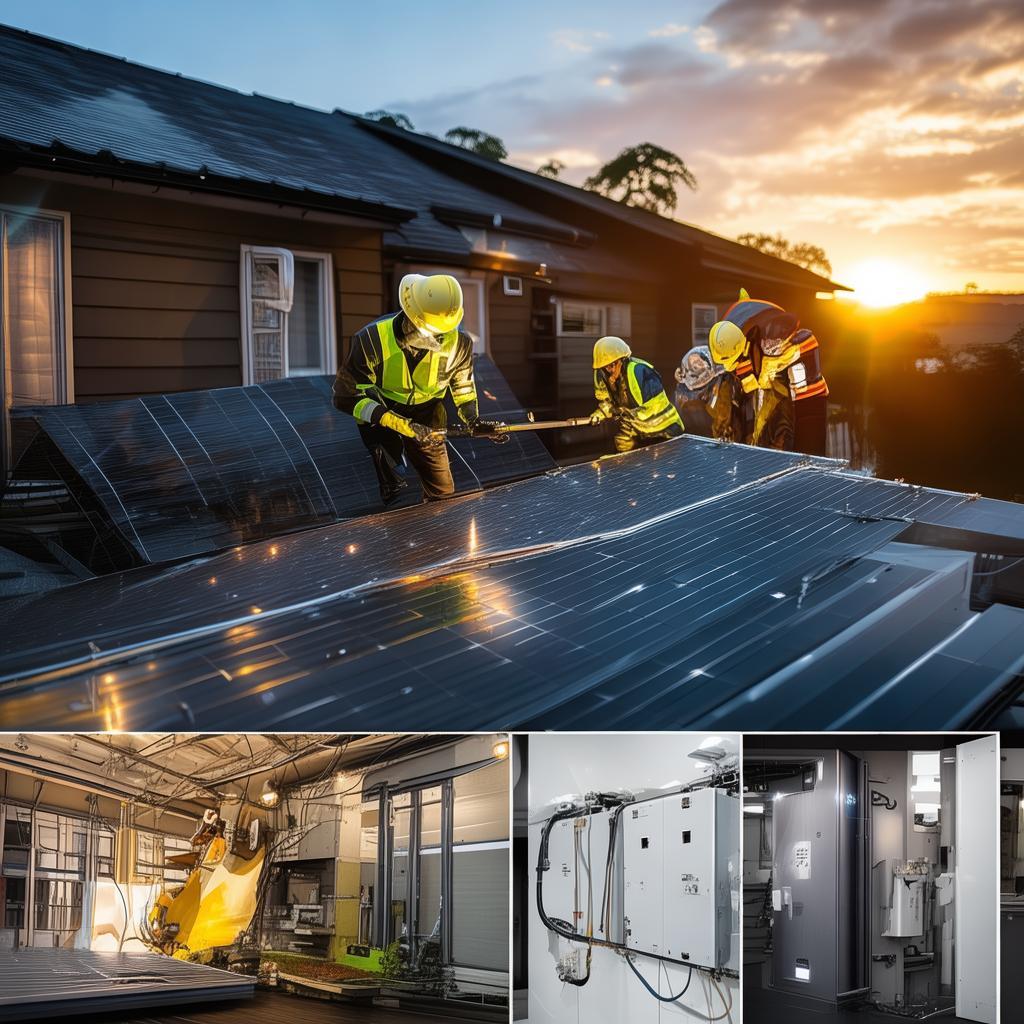
bifacial mono perc solar panels
Our bifacial mono PERC solar panels represent the pinnacle of photovoltaic technology, designed to maximize energy yield in diverse environmental conditions. Unlike traditional monofacial panels,
Bifacial Mono PERC Solar Panels
1. Product Overview
Our bifacial mono PERC solar panels represent the pinnacle of photovoltaic technology, designed to maximize energy yield in diverse environmental conditions. Unlike traditional monofacial panels, bifacial mono PERC solar panels capture sunlight from both the front and rear sides, leveraging reflected and diffused light to boost overall performance by up to 30%. This advanced design utilizes Passivated Emitter and Rear Cell (PERC) technology on high-quality monocrystalline silicon cells, ensuring superior efficiency and reliability for industrial-scale deployments.
Engineered for international trade and B2B applications, these panels are ideal for utility-scale solar farms, commercial installations, and off-grid systems. With power outputs ranging from 550W to 600W per panel, they deliver exceptional energy production per square meter, making them a cost-effective choice for projects demanding high returns on investment. The bifacial configuration excels in ground-mounted arrays where albedo from snow, sand, or white surfaces enhances rear-side generation, while robust framing and encapsulation guarantee long-term durability in harsh climates.
Backed by rigorous testing and compliance with international standards such as IEC 61215 and IEC 61730, our bifacial mono PERC solar panels offer a 30-year linear power warranty, underscoring their trustworthiness for global partners. Whether you're sourcing for large-scale solar parks in Europe, rooftop systems in Asia, or desert projects in the Middle East, these panels provide the efficiency and versatility needed to meet stringent project timelines and performance guarantees.
2. Key Features
- Bifacial Design: Generates power from both sides, increasing energy yield by 10-30% depending on installation height and surface reflectivity.
- Mono PERC Cells: High-efficiency monocrystalline cells with PERC passivation for minimized recombination losses and enhanced low-light performance.
- Half-Cut Cell Technology: Reduces shading effects and resistive losses, improving output under partial shading conditions common in commercial setups.
- Anti-PID and Anti-LID: Potential Induced Degradation (PID) and Light Induced Degradation (LID) resistance ensure stable performance over decades.
- Multi-Busbar (MBB) Configuration: Optimizes current collection, lowering series resistance and boosting fill factor for higher efficiency up to 22.5%.
- Transparent Backsheet: High-transparency POE encapsulation material allows optimal rear-side light transmission while providing superior moisture resistance.
- Anodized Aluminum Frame: Corrosion-resistant frame with reinforced corners for wind loads up to 5400 Pa and snow loads up to 8000 Pa.
- Low Temperature Coefficient: Maintains high performance in elevated temperatures, with a Pmax coefficient of -0.35%/°C.
3. Technical Specifications
| Parameter | Value |
|---|---|
| Product Series | Bifacial Mono PERC Solar Panels (BiHiKu6 / BiPERC Series) |
| Power Output (Pmax) | 550W - 600W (±3W tolerance) |
| Module Efficiency | 21.3% - 22.5% (front side); Bifaciality ≥70% |
| Cell Type | 182mm Mono PERC Half-Cut, 144 cells (6x24 configuration) |
| Dimensions (L x W x H) | 2278 x 1134 x 30 mm |
| Weight | 27.3 kg |
| Front Glass | 3.2 mm tempered glass with anti-reflective coating |
| Frame | Anodized silver aluminum alloy |
| Junction Box | IP68 rated, 3 diodes |
| Cable | 4.0 mm², 1400 mm length (customizable) |
| Maximum System Voltage | 1500V DC |
| Temperature Coefficients | Pmax: -0.35%/°C; Voc: -0.28%/°C; Isc: +0.045%/°C |
| Operating Temperature | -40°C to +85°C |
| Wind/Snow Load | 2400 Pa / 5400 Pa (wind); 5400 Pa / 8000 Pa (snow) |
| Certifications | IEC 61215, IEC 61730, UL 61730, CE, INMETRO, MCS |
| Warranty | 12-year product; 30-year linear power output (≥84.95% at year 30) |
4. Application Scenarios
Bifacial mono PERC solar panels are engineered for versatility across B2B applications, delivering optimized performance in real-world installations. In utility-scale solar farms, their bifacial design shines on elevated ground mounts over reflective surfaces like gravel or white membranes, maximizing land use and energy harvest for megawatt-hour projects.
For commercial and industrial rooftops, the panels' low weight and high efficiency suit flat or tilted roofs, where rear-side generation from building reflections adds substantial yield without additional footprint. In agri-photovoltaic systems, they enable dual-use of farmland, allowing crops to grow beneath while capturing diffuse light from the ground, ideal for sustainable agriculture in regions like Europe and North America.
Desert and high-albedo environments benefit immensely, as sand reflection boosts bifacial gains up to 25%, supporting large CSP-hybrid projects in the Middle East and Australia. Additionally, these panels excel in off-grid and floating solar setups, where water or snow reflection enhances output, ensuring reliable power for remote mining operations or island communities.
With compatibility for major trackers and fixed-tilt systems, bifacial mono PERC solar panels adapt to diverse topographies, from snowy alpine regions to tropical zones, providing consistent ROI for international EPC contractors and developers.
5. Advantages
The advantages of our bifacial mono PERC solar panels extend beyond standard PV modules, offering tangible benefits for long-term project success. Firstly, the bifacial technology delivers higher energy yield—up to 30% more than monofacial equivalents—translating to reduced balance-of-system costs and faster payback periods, critical for B2B financing models.
Superior low-irradiance performance ensures reliable generation during cloudy days or early/late hours, optimizing capacity factors in variable climates. The PERC cell architecture minimizes thermal losses, maintaining peak efficiency even at elevated module temperatures common in large arrays.
Durability is paramount: with enhanced PID resistance and robust mechanical design, these panels withstand extreme weather, reducing O&M expenses over their 30+ year lifespan. Lower degradation rates (0.4% annually) preserve value, while the high bifaciality factor guarantees consistent rear-side contribution regardless of installation specifics.
From an economic standpoint, bifacial mono PERC solar panels lower the levelized cost of energy (LCOE) by 10-15% through increased specific production, making them a strategic choice for competitive tenders. Their scalability supports seamless integration into hyperscale data centers, EV charging infrastructure, and green hydrogen facilities, aligning with global decarbonization goals.
6. Why Choose Us
As a leading manufacturer of bifacial mono PERC solar panels, we prioritize quality, innovation, and partnership in international trade. Our state-of-the-art production lines employ automated processes and Tier 1 silicon sourcing, ensuring every panel meets or exceeds global benchmarks. With ISO 9001, ISO 14001, and ISO 45001 certifications, we deliver bankable products trusted by top EPC firms worldwide.
We offer full customization—from power ratings to connector types—tailored to your project needs, supported by rapid prototyping and flexible MOQs for B2B scalability. Our global logistics network ensures timely delivery to ports across Europe, Asia, Americas, and beyond, with comprehensive packaging for safe transit.
Committed to transparency, we provide third-party test reports, EL imaging, and performance simulations using tools like PVSyst. Our technical support team assists with system design, yield modeling, and post-installation monitoring, fostering enduring relationships with distributors, installers, and developers seeking reliable bifacial mono PERC solar panels suppliers.
7. FAQ
Q: What makes bifacial mono PERC solar panels different from monofacial ones?
A: Bifacial panels generate power from both sides, capturing reflected light for 10-30% higher yield, while PERC technology enhances cell efficiency through rear passivation.
Q: What is the optimal installation height for maximum bifacial gain?
A: 0.5-1.5 meters above reflective surfaces like ground or white roofs, depending on albedo and tracker type; simulations recommended for site-specific optimization.
Q: Are these panels suitable for rooftop installations?
A: Yes, their lightweight design and high wind resistance make them ideal for commercial flat or sloped roofs, with rear-side gains from surrounding reflections.
Q: What warranties are provided?
A: 12 years on product materials and workmanship; 30 years on linear power output, guaranteeing at least 84.95% at year 30 under IEC standards.
Q: Do bifacial mono PERC solar panels perform well in low-light conditions?
A: Absolutely, with excellent low-irradiance response and half-cut cells minimizing shading losses, they outperform standard panels in diffuse light.
Q: What certifications ensure quality and safety?
A: IEC 61215/61730 for durability and safety, UL, CE, and others for global compliance, plus salt mist and ammonia resistance for harsh environments.
Q: Can these panels be used with tracking systems?
A: Yes, fully compatible with single- and dual-axis trackers, where bifacial gains can exceed 35% in high-albedo setups.
Related product
- English
- Françai
- Español
- Deutsch
- Română
- العربية
- 한국어
- 日本語
- Italiano
- Português
- Gaeilge
- Dansk
- Čeština
- Русский
- Afrikaans
- Euskara
- Català
- Esperanto
- हिन्दी
- Ελληνικά
- Bahasa Melayu
- Polski
- Српски
- Kiswahili
- ภาษาไทย
- Tiếng Việt
- Türkçe
- Svenska
- Cymraeg
- Slovenčina
- Latviešu
- Malti
- Magyar
- Galego
- ગુજરાતી
- Eesti Keel
- বাংলা
- Shqip
- беларуская мова
- Nederlands
- Tagalog
- ქართული
- Íslenska
- Kreyòl Ayisyen
- Lietuvių
- Norsk
- slovenščina
- தமிழ்
- Українська
- ײִדיש
- اردو
- తెలుగు
- فارسی
- македонски
- ಕನ್ನಡ
- Bahasa Indonesia
- עברית
- Suomi
- Hrvatski
- Български
- Azerbaijani