

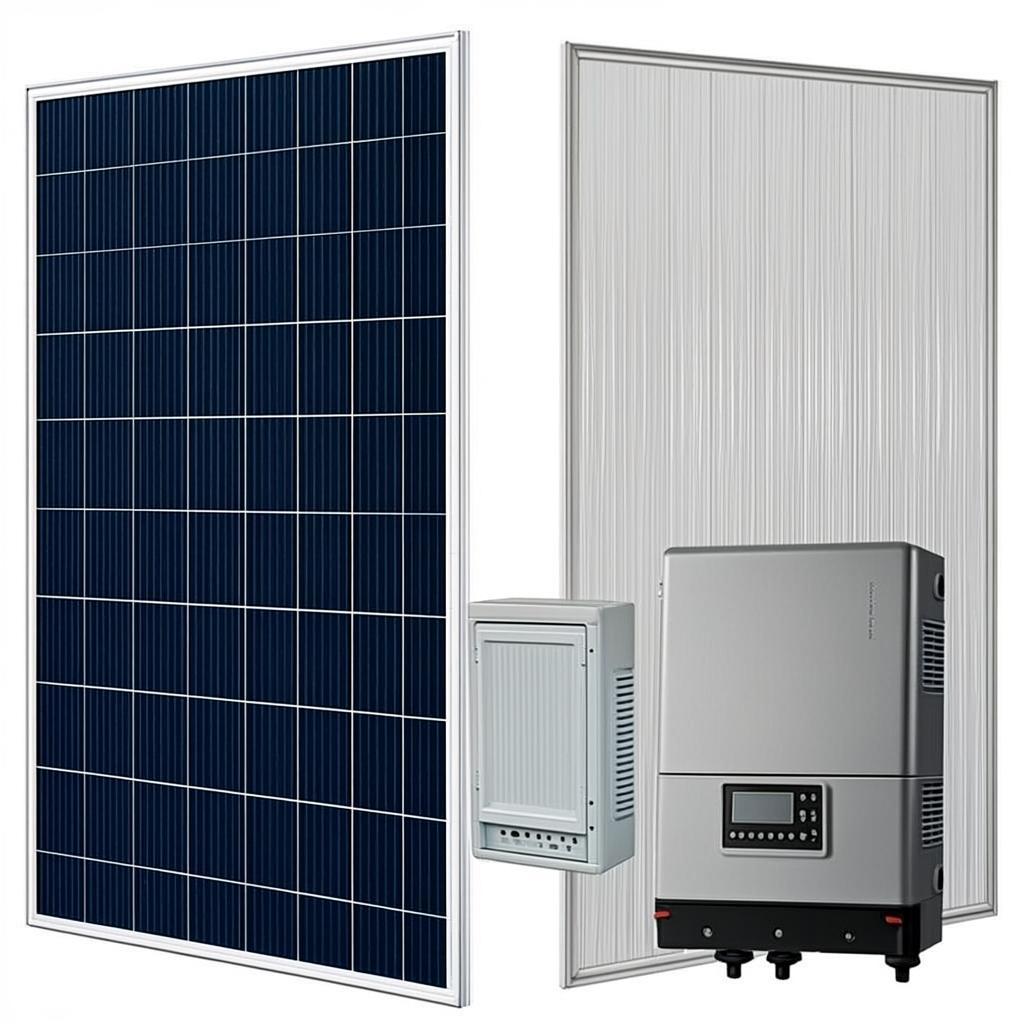
are bifacial solar panels better
In the evolving landscape of renewable energy, one question dominates discussions among procurement managers and engineers: are bifacial solar panels better than traditional monofacial alternatives?
Are Bifacial Solar Panels Better? Comprehensive Guide for B2B Buyers
Product Overview
In the evolving landscape of renewable energy, one question dominates discussions among procurement managers and engineers: are bifacial solar panels better than traditional monofacial alternatives? The resounding answer is yes, particularly for commercial and utility-scale installations where maximizing energy yield is paramount. Bifacial solar panels represent a technological leap, capturing sunlight from both the front and rear surfaces to boost overall efficiency by up to 30% compared to standard panels.
Our bifacial modules utilize advanced N-type TOPCon or PERC half-cut cell technology, enabling them to harness reflected and diffused light effectively. This design not only enhances performance in diverse environmental conditions but also delivers superior return on investment (ROI) over the panel's 30-year lifespan. Ideal for international trade and large-scale deployments, these panels are engineered to meet stringent global standards, including IEC 61215 and IEC 61730 certifications.
Whether you're outfitting solar farms, commercial rooftops, or ground-mounted systems, bifacial technology addresses key pain points like low irradiance and shading. By integrating seamlessly into existing EPC workflows, they offer a future-proof solution that outperforms conventional panels, making them a strategic choice for savvy B2B buyers seeking long-term energy optimization.
Key Features
- Dual-Side Power Generation: Absorbs direct sunlight on the front and up to 25-30% additional energy from the rear via albedo reflection, directly answering why many professionals conclude are bifacial solar panels better in real-world applications.
- High-Efficiency Cells: N-type bifacial cells with efficiencies exceeding 22.5%, minimizing degradation and ensuring stable output over decades.
- Anti-PID and Anti-LID Technology: Robust protection against potential induced degradation (PID) and light-induced degradation (LID), guaranteeing less than 0.55% annual degradation.
- Enhanced Durability: Tempered glass on both sides with IP68 junction boxes, wind load resistance up to 2400 Pa, and snow load up to 5400 Pa.
- Optimized Bifaciality Factor: Greater than 70%, maximizing rear-side contribution in various mounting configurations.
- Smart Compatibility: Compatible with trackers, fixed-tilt systems, and agrivoltaic setups for versatile deployment.
Technical Specifications
| Parameter | Value | Notes |
|---|---|---|
| Module Type | Bifacial TOPCon Half-Cut | N-type monocrystalline |
| Nominal Power (Front Side) | 550-580W | STC: 1000W/m², 25°C, AM 1.5 |
| Bifacial Gain | Up to 30% | Depends on albedo and installation height |
| Module Efficiency (Front) | 21.5%-22.8% | Industry-leading performance |
| Dimensions (L x W x H) | 2278 x 1134 x 30mm | Lightweight at 27.5kg |
| Cell Count | 144 (6x24) | Half-cut design reduces losses |
| Maximum System Voltage | 1500V DC | Suitable for large arrays |
| Temperature Coefficient (Pmax) | -0.30%/°C | Excellent low-light performance |
| Warranty | 15-year product, 30-year linear power | First-year degradation <2%, annual <0.55% |
| Certifications | IEC 61215, IEC 61730, UL 61730, TUV | CE, INMETRO, UKCA compliant |
| Junction Box | IP68, 3x20A diodes | MC4 connectors compatible |
These specifications position our bifacial panels as a superior choice, consistently proving that are bifacial solar panels better when evaluated against monofacial benchmarks in power output and longevity.
Application Scenarios
Bifacial solar panels excel in a wide array of B2B deployment scenarios, where their ability to leverage ground reflection translates to measurable gains. In utility-scale solar farms, elevated mounting (0.5-2m height) on white gravel or high-albedo surfaces can yield 15-25% more energy, making them ideal for desert or open-field projects in regions like the Middle East, Australia, or the southwestern US.
For commercial and industrial rooftops, bifacial modules perform exceptionally on light-colored membranes or metal roofs, capturing reflected light without additional infrastructure costs. In agrivoltaic systems, they allow dual land use—generating power above crops—boosting farm productivity while addressing land scarcity in Europe and Asia.
Ground-mounted trackers amplify bifacial benefits, with rear-side generation increasing during high-sun-angle periods. Even in urban settings with partial shading, their low temperature coefficients ensure reliable output. Across these scenarios, data from field tests confirms: are bifacial solar panels better? Absolutely, especially for projects prioritizing LCOE (levelized cost of energy) reduction and energy independence.
Advantages
When buyers deliberate are bifacial solar panels better, the advantages stack decisively in their favor. Foremost is the energy yield uplift: real-world bifaciality delivers 10-30% more kWh annually, shortening payback periods by 1-2 years versus monofacial panels. This is particularly evident in low-light or diffuse radiation environments, where rear-side capture compensates for suboptimal front-side irradiance.
Financially, bifacial panels lower the overall system BOS (balance of system) costs per watt by optimizing land use—fewer modules needed for the same capacity. Their resilience to hotspots, microcracks, and environmental stressors extends operational life, with warranties backing 87-92% output retention at year 30.
Environmentally, higher efficiency means reduced carbon footprint per kWh generated, aligning with ESG mandates for corporate buyers. Mechanically superior with multi-busbar (MBB) technology, they exhibit lower soiling rates and better wind/snow resistance. Independent studies from NREL and Fraunhofer ISE validate these gains, underscoring why forward-thinking procurers overwhelmingly affirm that bifacial solar panels are indeed better for scalable, sustainable power generation.
Why Choose Us
As a tier-1 manufacturer with over a decade in bifacial innovation, we empower B2B partners worldwide with panels that exceed expectations. Our state-of-the-art automated production lines ensure batch-to-batch consistency, backed by TUV-audited quality control and bankable 30-year performance guarantees.
We prioritize supply chain reliability, with capacities exceeding 10GW annually and global logistics for seamless international trade. Customized solutions, from OEM branding to project-specific optimizations, cater to EPC firms and developers. When evaluating are bifacial solar panels better, partner with us for proven ROI, rapid delivery, and unmatched technical support that turns procurement into partnership.
FAQ
Are bifacial solar panels better for all installations?
Yes, in most cases, especially elevated or reflective ground mounts. For flat black roofs, gains are 5-10%; optimal setups yield 20-30% more energy.
How do bifacial solar panels work?
They generate power from both sides: front via direct light, rear via reflected/diffused light. Bifaciality factor >70% ensures substantial rear contribution.
What is the ROI impact if are bifacial solar panels better?
Typically 15-25% higher yield reduces LCOE by 10-20%, accelerating payback to 4-6 years depending on location and incentives.
Do bifacial panels require special mounting?
No, but 0.5m+ height and high-albedo surfaces maximize gains. Compatible with standard racking and trackers.
Are there any drawbacks to bifacial solar panels?
Slightly higher upfront cost offset by lifetime yield; minor dust accumulation on rear mitigated by design and cleaning.
What warranties do your bifacial panels offer?
15-year product warranty, 30-year linear power output (84.8% at year 30), with rigorous third-party testing.
Related product
- English
- Françai
- Español
- Deutsch
- Română
- العربية
- 한국어
- 日本語
- Italiano
- Português
- Gaeilge
- Dansk
- Čeština
- Русский
- Afrikaans
- Euskara
- Català
- Esperanto
- हिन्दी
- Ελληνικά
- Bahasa Melayu
- Polski
- Српски
- Kiswahili
- ภาษาไทย
- Tiếng Việt
- Türkçe
- Svenska
- Cymraeg
- Slovenčina
- Latviešu
- Malti
- Magyar
- Galego
- ગુજરાતી
- Eesti Keel
- বাংলা
- Shqip
- беларуская мова
- Nederlands
- Tagalog
- ქართული
- Íslenska
- Kreyòl Ayisyen
- Lietuvių
- Norsk
- slovenščina
- தமிழ்
- Українська
- ײִדיש
- اردو
- తెలుగు
- فارسی
- македонски
- ಕನ್ನಡ
- Bahasa Indonesia
- עברית
- Suomi
- Hrvatski
- Български
- Azerbaijani