

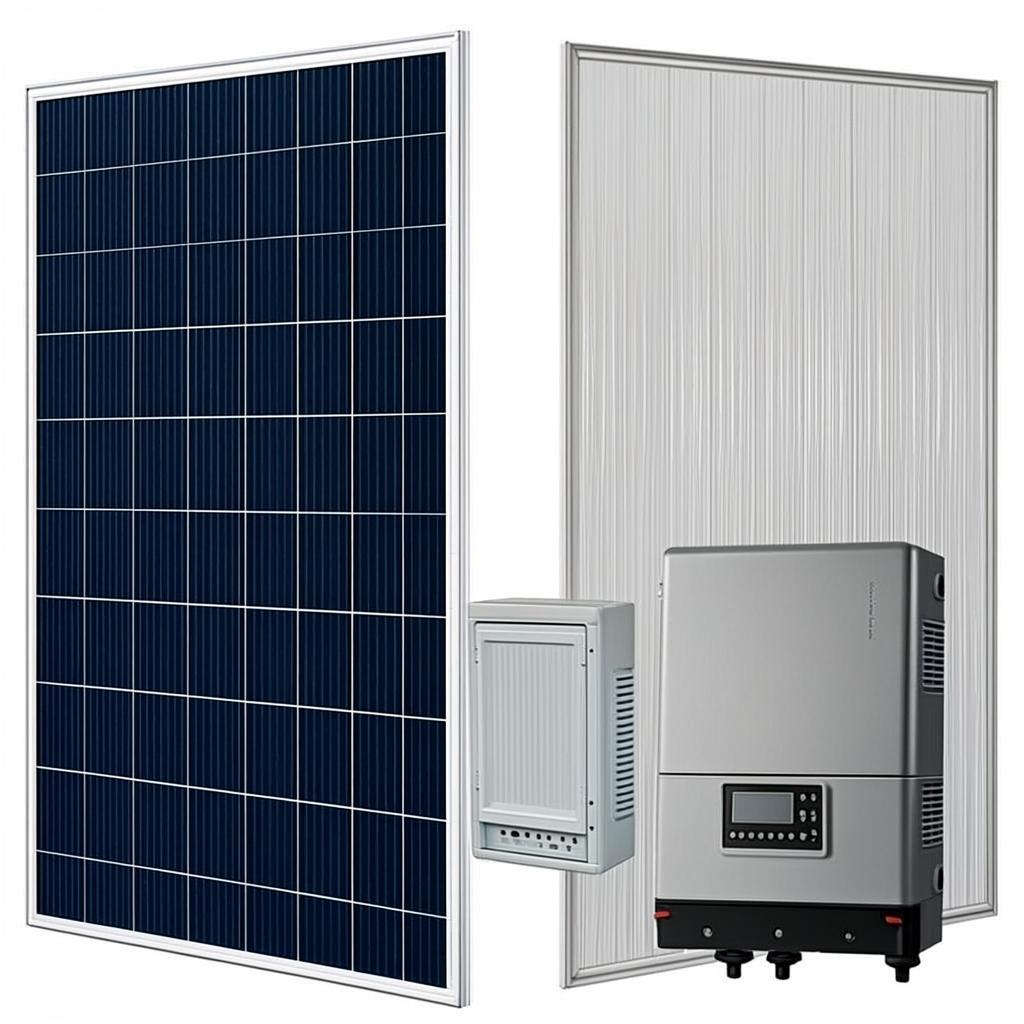
bifacial vs monofacial solar panel
In the rapidly evolving world of renewable energy, understanding bifacial vs monofacial solar panel technology is essential for informed procurement decisions in international trade. Monofacial solar
Bifacial vs Monofacial Solar Panel: The Ultimate Comparison Guide
1. Product Overview
In the rapidly evolving world of renewable energy, understanding bifacial vs monofacial solar panel technology is essential for informed procurement decisions in international trade. Monofacial solar panels, the traditional standard, capture sunlight exclusively on their front surface, converting it into electricity with efficiencies typically ranging from 18% to 22%. These panels feature a single-layer cell design, often using PERC (Passivated Emitter and Rear Cell) technology, making them reliable for standard installations.
Bifacial solar panels, on the other hand, represent a technological leap forward. They generate power from both the front and rear sides, harnessing reflected and diffused light from the ground, snow, or surrounding surfaces. This dual-sided absorption can boost overall energy yield by 10-30%, depending on installation conditions. The bifacial vs monofacial solar panel debate centers on performance metrics like bifaciality factor (the ratio of rear to front efficiency, often 70-90%) and albedo (surface reflectivity), which directly impact real-world output.
For B2B buyers in solar projects across Europe, Asia, and North America, bifacial panels offer superior long-term ROI due to higher specific yields per square meter. Monofacial panels remain cost-effective for space-constrained applications, but bifacial technology aligns with global trends toward maximizing energy harvest amid rising panel prices stabilizing below $0.25/Wp. This overview equips wholesalers, EPC firms, and developers to evaluate bifacial vs monofacial solar panel options based on project scale, site conditions, and budget constraints.
2. Key Features
- Dual-Side Power Generation (Bifacial Exclusive): Bifacial panels utilize transparent backsheets or glass-glass encapsulation, enabling rear-side efficiency up to 90% of front-side performance. Monofacial panels lack this capability, limiting output to direct irradiance.
- Enhanced Efficiency and Yield: In bifacial vs monofacial solar panel comparisons, bifacial models achieve 400-700W output in 72-cell formats, with rear-side gains amplifying total production in high-albedo environments like deserts or snowy regions.
- Superior Durability: Both types feature anti-PID (Potential Induced Degradation) coatings, but bifacial panels often use double-glass designs for better resistance to microcracks, hail, and ammonia corrosion—ideal for agrivoltaic or floating solar farms.
- Optimized Temperature Coefficient: Bifacial panels exhibit lower thermal losses (-0.28%/°C vs. -0.35%/°C for monofacial), maintaining higher performance in hot climates common to Middle Eastern and Australian markets.
- Versatile Mounting Compatibility: Bifacial excels in elevated ground mounts with 30-50cm height for rear light access; monofacial suits flat rooftops without modification.
- Certifications and Warranty: Both meet IEC 61215/61730 standards, but bifacial panels from Tier 1 manufacturers offer 30-year linear power warranties with <0.4%/year degradation.
These features highlight why bifacial vs monofacial solar panel analysis often favors bifacial for utility-scale projects exceeding 10MW.
3. Technical Specifications
| Parameter | Monofacial Solar Panel | Bifacial Solar Panel |
|---|---|---|
| Cell Type | Mono PERC Half-Cut | N-Type TOPCon or HJT Half-Cut |
| Front Efficiency | 21.5-22.5% | 22.0-23.5% |
| Bifaciality Factor | N/A | 70-85% |
| Power Output (72-cell) | 540-570W | 600-700W (front + rear gain) |
| Dimensions (mm) | 2278 x 1134 x 30 | 2278 x 1134 x 30 |
| Weight (kg) | 27.5 | 28-33 (glass-glass) |
| Temperature Coefficient (Pmax) | -0.35%/°C | -0.28%/°C |
| Maximum System Voltage | 1500V DC | 1500V DC |
| Junction Box | IP68, 3 diodes | IP68, 3 diodes |
| Warranty | 12 years product, 25-30 years power | 12 years product, 30 years power |
| Estimated Energy Yield Gain | Baseline | +10-30% over monofacial |
This table provides a side-by-side bifacial vs monofacial solar panel spec comparison, underscoring bifacial's edge in yield and longevity for demanding B2B applications.
4. Application Scenarios
When evaluating bifacial vs monofacial solar panel for specific projects, site albedo and mounting height are pivotal. Monofacial panels thrive in rooftop solar systems for commercial buildings, where rear-side access is obstructed. Their proven track record suits urban distributed generation (DG) projects under 5MW, integrating seamlessly with inverters like Huawei or SMA.
Bifacial panels dominate utility-scale ground-mounted farms, especially on reflective surfaces such as white gravel (albedo 0.5+), sand dunes, or snow-covered terrains. In agrivoltaics, they allow dual land use—shade for crops below while harvesting rear-diffused light. Floating PV installations benefit from water reflection, yielding 15-25% more than monofacial equivalents.
For international trade, bifacial suits high-irradiance regions like India, Saudi Arabia, or California deserts. Monofacial remains viable for shaded or low-cost residential/commercial retrofits in Europe. Hybrid approaches combine both in large portfolios to optimize CAPEX and OPEX.
5. Advantages
The bifacial vs monofacial solar panel comparison reveals clear bifacial superiorities for forward-thinking buyers. First, energy yield advantages translate to shorter LCOE (Levelized Cost of Energy), often 5-15% lower over 25 years due to rear-side contributions. This is quantifiable via tools like PVsyst simulations, factoring ground albedo and tilt angle.
Durability stands out: glass-glass bifacial constructions resist PID, LID (Light Induced Degradation), and mechanical stress better, with first-year degradation under 1%. Lower BOS (Balance of System) costs arise from fewer panels needed for the same MWac output.
Sustainability metrics favor bifacial, with recyclable glass encapsulants and carbon footprints reduced by higher yields. In trade terms, bifacial panels command premium pricing but deliver faster payback (4-6 years vs. 6-8 for monofacial) in optimal setups. Monofacial's primary advantage is upfront affordability, but bifacial future-proofs investments amid net-zero mandates.
6. Why Choose Us
As a Tier 1 manufacturer and exporter specializing in bifacial vs monofacial solar panel solutions, we deliver bankable quality backed by BloombergNEF rankings. Our state-of-the-art production lines in Southeast Asia ensure >99% uptime, with automated ABC (All Back Contact) cells for unmatched bifaciality.
We offer customized OEM/ODM services, from 550W monofacial to 700W bifacial modules, certified by TUV, UL, and CEC. Global logistics via major ports guarantee lead times under 4 weeks for container loads. Our R&D team provides free PVsyst modeling to demonstrate bifacial vs monofacial solar panel gains tailored to your sites.
With 10GW+ annual capacity and partnerships across 50+ countries, we prioritize supply chain transparency, conflict-free materials, and extended warranties. Choose us for reliability that scales from pilot projects to GW portfolios.
7. FAQ
Q: What is the main difference in bifacial vs monofacial solar panel performance?
A: Bifacial panels generate power from both sides, adding 10-30% yield via rear absorption, while monofacial relies solely on front-side light.
Q: Are bifacial panels more expensive than monofacial?
A: Initial costs are 5-10% higher, but bifacial's superior yield reduces LCOE, offering better ROI in ground-mount systems.
Q: What albedo is ideal for bifacial panels?
A: Albedo >0.3 (e.g., white surfaces, water, snow) maximizes gains; simulations confirm 20%+ uplift over monofacial baselines.
Q: Can bifacial panels be used on rooftops?
A: Yes, but gains are minimal (<5%) due to shading; monofacial is preferable for flat or low-tilt roofs.
Q: How do warranties compare in bifacial vs monofacial solar panels?
A: Both offer 25-30 years, but bifacial often includes higher end-of-life guarantees (88% at year 30) thanks to advanced passivation.
Q: What certifications should I look for?
A: IEC 61215/61730 for durability, UL 61730 for safety, and PID testing. Our panels exceed these standards.
Q: Is bifacial technology mature for large-scale projects?
A: Absolutely—over 50GW installed globally, powering mega-projects in the US, China, and Australia with proven bankability.
Related product
- English
- Françai
- Español
- Deutsch
- Română
- العربية
- 한국어
- 日本語
- Italiano
- Português
- Gaeilge
- Dansk
- Čeština
- Русский
- Afrikaans
- Euskara
- Català
- Esperanto
- हिन्दी
- Ελληνικά
- Bahasa Melayu
- Polski
- Српски
- Kiswahili
- ภาษาไทย
- Tiếng Việt
- Türkçe
- Svenska
- Cymraeg
- Slovenčina
- Latviešu
- Malti
- Magyar
- Galego
- ગુજરાતી
- Eesti Keel
- বাংলা
- Shqip
- беларуская мова
- Nederlands
- Tagalog
- ქართული
- Íslenska
- Kreyòl Ayisyen
- Lietuvių
- Norsk
- slovenščina
- தமிழ்
- Українська
- ײִדיש
- اردو
- తెలుగు
- فارسی
- македонски
- ಕನ್ನಡ
- Bahasa Indonesia
- עברית
- Suomi
- Hrvatski
- Български
- Azerbaijani